Public Steam disclosure research24,658 disclosures tracked
Where do games disclose AI use?
Search developers’ Steam disclosures, compare classified AI use across
games, and follow recorded changes.
This index adds cross-game classifications and statistics to
statements published on individual store pages.
Groups reflect automatic analysis of public disclosures; mature records are excluded. These counts do not measure AI use across all of Steam.
Missing or unclear statements cannot establish whether a game uses AI.
Generative AI was used during development to create some pre-generated background art, character portraits, promotional images, dialogue, and music. No AI content is generated while the game is running.
HearthMoon uses AI to generate NPC dialogue during gameplay and synthesize NPC voices. Spoken input is transcribed so villagers and the dragon companion can respond to the player. AI-assisted artwork and writing are also used in development and in store-page marketing. Conversations are experimental and responses may be inconsistent.
AI tools assisted with static artwork, marketing images and localization. During play, a bundled language model running locally on your PC generates dialogue, narrative and diary text from your input, card instructions and conversation context. No external AI service or API key is required. No images or voices are generated during play. Output quality, response time and consistency vary with your hardware and input.
Please note that non-Japanese localization is currently generated by AI. I plan to replace this with professional human localization in the future.
Furthermore, one sound effect was created using AI.
All other elements have been meticulously crafted by myself.
StoryNow uses generative AI locally during gameplay. Llama.cpp generates prompts that ComfyUI uses to create visual-novel artwork on the player's device. The game does not connect to an external AI generation service.
AI tools were used during development to create pre-made content such as images, voices, music and 3D model drafts. Everything was selected, edited and integrated into the game by the developer. The game does not generate any content with AI while you play and does not connect to AI services.
Generative AI is used during development to create visual and music assets for the game and its promotional materials. It is not used to create the scenario, written text, or voices. All AI-generated assets are pre-generated; the game does not generate content or connect to external AI services during gameplay.
AI was used as a supporting tool during the development of this game. However, the original game idea and its underlying concept were created several years ago and were developed entirely independently of AI.
The entire project is being created by a solo developer with a university degree in Game Design. Over the years, several hundred hours of work, experience, creativity, and personal passion have gone into the concept, development, and realization of the game.
AI was used to assist with certain parts of the development process. This includes support with coding as well as some aspects of soundtrack and visual asset creation. Many of the visual assets were subsequently edited, refined, adapted, or partially recreated manually using image editing software to achieve the intended style and quality.
AI was also used as a supporting tool for written content, primarily to make minor improvements to texts written by the developer and to correct grammar and wording.
AI therefore serves as an additional tool within the development process. The original game concept, game design, creative decisions, final direction, and implementation of the game remain the work of the developer. Various sounds and some of the soundtracks used in the game were also created and composed by the developer.
Some pre-made content was created with the help of generative AI tools and then edited by our team: parts of the key art and logo, some 3D models, some UI/ability icons, and some character voice lines. AI coding assistants were also used during development. Gameplay design and level design were done by the developers. The game does not generate any AI content live during gameplay.
As a small indie team, we use generative AI to assist with coding and parts of our art workflow. All AI-assisted code is manually tested by our team before being included in the game. Our artists create the original concepts and visual direction, while AI is used as a supporting tool during the art process. All final artwork is manually refined and finished by our artists.
A small language model (Google's Gemma 3 270M) runs entirely on the player's computer, with no network connection. It writes short lines of villager small talk, the ritual oracle's one- or two-sentence hint after a failed ritual, and routine filler records in the in-game archive, and it chooses which of our pre-written dialogue lines fits the moment.
Guardrails: the player never types to the model — there is no text input anywhere in the game. Every prompt is a fixed template we wrote, filled in from game state such as a character's name, the time of day and the current quest. Output is short by construction (hard token caps, and lines over a few words are cut or discarded); lines that read as narration, stage directions or an assistant speaking are rejected; dialogue choices are constrained to our own authored lines. Any failure falls back to written lines. Players can turn the model off in Settings, and the game plays identically on written lines alone.
This game utilizes generative AI for a significant portion of its art assets. Many AI-assisted elements underwent manual editing and modification by the developer before being integrated into the final game.
InteractiVR uses generative AI during play. The interviewer characters are driven by a large language model that generates their questions, follow up questions and responses live, in response to what the player says and to the job role and experience level the player selects. Player speech is transcribed by automatic speech recognition, and interviewer dialogue is spoken using synthesized voice. The written performance report at the end of a session is also AI generated.
The AI is constrained by a system prompt scoped to job interview conversation and to evaluating answers against the STAR method. It does not depict or impersonate real people. Interviewer characters are fictional.
The AI evaluates the structure and completeness of a player's answers against the STAR method. It is a practice and training tool and does not make hiring decisions.
Generative AI tools were used during development to assist in creating pre-generated audio and other selected content. These assets are reviewed and integrated by the developer before being included in the game or its promotional materials. The game does not use real-time generative AI during gameplay.
Artificial intelligence was used to assist in development, primarily for the front end, and AI generated content is used in game for text and voices via local models ran on the player's system or external models provided by the player.
Some character portraits were created with generative AI. AI tools were also used to help write and translate the store page and to translate the game's text. The story and dialogue were written by our team.
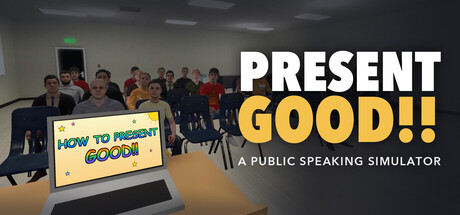
After a talk, audience questions are generated at runtime by a small open-weight language model (Qwen3) running locally on the player's computer, based on a transcript of what the player just said. Speech-to-text also runs locally (whisper.cpp). Nothing is sent to any server.
AI-assisted tools were utilized during the development of this game (including visual art, sound design, and workflow optimization) to achieve higher quality. Every final element has been curated, reviewed, and integrated under the direct supervision of the development team.
ARIA's dialogue and speech are generated on the player's own machine at runtime by a language model and a text-to-speech voice that ship with the game. Nothing is sent to an external service and no player data leaves the machine. What ARIA says is constrained to the station's fiction and to evidence the player has actually found in-game. Some art, audio and text assets in the game were produced with AI tools and reviewed by the developer before shipping.
Peso Pena uses generative AI tools during production, under the direction and review of our team. AI was used to create pre-rendered visual assets, including character illustrations, sprites and animation frames, backgrounds, store artwork and trailer/cutscene footage, all of which were curated, edited and approved by our artists. Some in-game and store texts were drafted or translated with AI assistance and then reviewed by the team. The game does not generate any content at runtime: every image, animation, text and sound that players see is fixed and was reviewed before release.
DAWNBLOOM uses generative AI-assisted tools during the development of certain game content. The in-game “Dawnbloom Spirit” feature connects to a generative AI service to provide real-time text responses to players’ game-related questions, including game knowledge, gameplay explanations, and general guidance. This feature generates auxiliary text content only. It does not generate or modify game code, nor does it directly control game rules, character data, or player assets.
All artwork, animation, writing, character designs and other creative content in this game were made by hand. None of it was created with generative AI.
Generative AI was used only in two parts of development:
Programming assistance: helping to write and debug parts of the game code.
Translation assistance: helping to translate the text for non-Chinese language versions.
The artwork and writing that players see in the game were not generated by AI.
Time Traveler: Divergence uses locally running generative AI to enable dynamic NPC conversations. AI-generated dialogue is constrained by the game's predefined rules, characters, world knowledge, and simulation state. AI is also used locally to generate voice-over for these dynamic conversations. No external AI service is required during gameplay.
The use of AI is limited to select visual assets, which were manually reviewed, repainted, and integrated to fit the art direction. The project features original artwork hand-drawn by my artistic partner alongside an original acoustic piano score, entirely composed and performed by me.
This is an independent, completely free passion project with zero monetization, made out of a genuine love for game development. Thank you for playing.
Some of the pre-made content in this game (such as artwork, audio and/or text) was created with the help of generative AI tools and was reviewed and edited by the developer. No AI content is generated during gameplay.
Generative AI was used to assist in creating some in-game content, as well as store and library artwork. AI tools also assisted with store descriptions and translations.
Pre-generated content only. The game contains no live or runtime AI generation and makes no network connection.
Visual art: the pixel art in this game — sprites, backgrounds, key art, banners and icons — was produced with the assistance of generative AI image tools and then edited, composited, recoloured and assembled by hand for use in the game.
Written content and store text: the encounter text and the store description were written with AI assistance and edited by the developer.
Everything shipped was reviewed by a human before it went in. No content is generated while the game is running.
Generative AI was used to create background images and character artwork in the game. It was also used as a writing aid for proofreading and editing the narrative. AI-assisted content was reviewed and selected by the developer.
Generative AI tools assisted in producing content for the game and its store materials, including some images, music and character voices. Starlit Hall Studio designs, selects, revises, integrates and reviews the final content. All content is prepared before release; the game does not generate content or connect to generative AI services during play.