Public Steam disclosure research25,986 disclosures tracked
Where do games disclose AI use?
Search developers’ Steam disclosures, compare classified AI use across
games, and follow recorded changes.
This index adds cross-game classifications and statistics to
statements published on individual store pages.
Groups reflect automatic analysis of public disclosures; mature records are excluded. These counts do not measure AI use across all of Steam.
Missing or unclear statements cannot establish whether a game uses AI.
Art: Certain background, character, and animation assets were generated by AI, then manually cropped, composited, and post-processed.
Audio: Some in-game music and sound effects were generated by AI, then manually selected, edited, and integrated.
Code: Some foundational functional code was generated with AI assistance, then reviewed, modified, compiled, and integrated by the developers.
The core game design, gameplay logic, and final integration were all completed manually.
Defense of Kyrath uses AI-assisted tools in parts of its art and audio pipeline. Some character sprites, character voice lines, select background imagery, and background music are AI-generated, and refined or curated by the developer. All AI-generated content is pre-generated at authoring time. Terrain, environment art, and level layouts come from TiGen - a custom procedural generation pipeline that is purely algorithmic, not AI. All game design, writing, and gameplay systems are human-crafted.
No real-time generative AI in the client. Static in-game and store art/audio may include material initially produced with generative AI, revised and approved by the developer before release.
AI technology is used in a supplementary capacity during the conceptual and prototyping stages of our 2D assets. Any such assets are replaced through our production pipeline by our artists.
Some visual assets in the game, including promotional images and artwork, were created or assisted using AI tools. All assets were reviewed and adjusted before use.
Currently only AI generated item is the Store graphics.
It is, however, intended in the future for the game itself to contain AI generated graphics as well.
During the development of this game, generative AI tools were used to assist in creating early drafts of some background images, UI icons, and text. All AI-generated assets have been strictly reviewed and manually modified by the developer to ensure they fit the game's aesthetic and do not contain any copyrighted or inappropriate content.
How does this game use generative AI?
-Musical Content: The soundtrack was generated using AI tools (Suno), then curated and produced to match the game's atmosphere and biomes.
-Visual Content and Assets: AI tools were used as a base for some illustrations and visual elements. All of these assets have been manually reviewed, edited, and refined by the developer to ensure final quality and consistency with the project's art style.
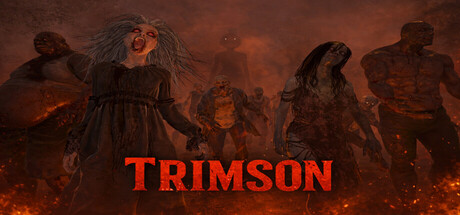
Generative AI is used in limited areas of TRIMSON. Character voice lines are created using Deep Voice Pro, a Unity Asset Store asset. Selected in-game icons are based on original artwork created by the developer's daughter, with AI tools used only for editing and refinement. The cover artwork was originally created by the developer, with AI tools used only for editing and refinement.
TRIMSON also uses licensed music assets from Cplomedia purchased through the Unity Asset Store. Some of these licensed music assets contain AI-generated content.
No other content in TRIMSON uses generative AI.
Some visual assets in this game, such as the capsule art, were generated with the assistance of AI tools and then edited and refined by the developer. No gameplay, mechanics, or code were generated by AI.
Some content in this game was created with the assistance
of generative AI tools, including: game artwork (ChatGPT/DALL-E),
background music (Suno AI), and some text content (Claude AI).
All AI-generated content has been reviewed and adjusted by the developer.
Most in-game visual assets were generated using AI tools, while all implementation, including placement and animation, was handled by the developers.
The user interface was created using non-AI assets and implemented by the development team.
We are an indie team of two programmers. We are currently using AI-generated art so we can start testing the game right away. Thank you for your understanding.
Some textures and 3D models in this game were created using AI-assisted procedural rendering during development. The game does not generate any content with AI at runtime.
AI tools were utilized to assist with text correction and translation. Additionally, AI was used to refine certain artwork, as well as to generate certain audio elements.
All other aspects of the project, from creative direction and story to core gameplay and scripting, represent the dedicated, hand-crafted effort of a solo developer.
I'm Alex, a solo developer. Most of Sphere TD is handmade by me: towers, mods, UI, maps, game design, and core gameplay art.
A small amount of AI assisted creation is used for flavor: optional map background images (off by default), and music tracks that combine indie production with AI assisted composition.
I also have a no AI assets switch in Settings to toggle off generated content if you prefer.
How I use AI:
To have it translated.
To have it coded.
To have the Impressionist-style-like paintings I painted transformed into accurate, precise images.
To have the songs I composed enhanced with various instruments.
This game was built extensively with generative AI. AI tools were used to assist with code development, pixel art generation, music composition, sound effect creation, voice acting, dialogue writing, story design, and game design.
Mix a Meow uses AI generation tools to create some assets, including character illustrations, icons, music, and sound effects. All character concepts and design directions were crafted by the developer; AI was used as a tool to bring them to life. No content is generated by AI during gameplay — all AI-assisted assets were reviewed and finalized by the developer before release.
This game utilizes generative AI tools to assist in the creation of select 2D artwork, specifically some UI icons, league background themes, and store page promotional materials. Other in-game assets, such as enemy art and player icon and GUI, were acquired through licensed asset stores.
**About the Use of AI**
This game was largely developed by a single developer with limited resources. To move faster and support certain parts of the creative process, I occasionally used AI tools during development.
AI was mainly used to help generate early drafts of visuals, initial text ideas, and to assist throughout the production process. However, everything you see in the game has been manually refined, reworked, and shaped to fit the overall vision of the game.
My goal was not to use AI as a shortcut, but as a supportive tool to help bring ideas to life more efficiently. This allowed me to focus more on the atmosphere, gameplay, and overall experience I wanted to create.
The final result — its world, mechanics, and feeling — reflects my own vision.
Some visual assets in this game, including backgrounds and certain enemy designs, were created using AI-assisted tools and then edited, modified, and integrated into the game by the developer.
Generative AI has been used during the development of this game in the following ways: AI tools were used to assist in writing part of the game's source code and to help create or refine some 2D graphic assets, such as logos and UI elements.
Some visual assets (illustrations and portraits) and the music were created with the help of AI tools. The game code was developed with AI-assisted programming. All content was reviewed, curated, and approved by the developer.
The Steam store page banners and promotional materials were created with the help of generative AI tools. The in-game assets were either manually created or edited afterward, while certain marketing visuals (such as headers, capsules, and banners) contain AI-generated elements.
This game uses generative AI during development for certain 2D icons, concept art, placeholder graphics, and text. All AI-generated content has been manually reviewed, edited, and adapted by the developer before being included in the final game.