Public Steam disclosure research25,993 disclosures tracked
Where do games disclose AI use?
Search developers’ Steam disclosures, compare classified AI use across
games, and follow recorded changes.
This index adds cross-game classifications and statistics to
statements published on individual store pages.
Groups reflect automatic analysis of public disclosures; mature records are excluded. These counts do not measure AI use across all of Steam.
Missing or unclear statements cannot establish whether a game uses AI.
Generative AI "Gemini" was utilized across various stages of development, including coding and image generation.
While AI helped improve development efficiency, all final adjustments and quality control were performed manually with the utmost care to ensure the best possible experience for our players.
Voice synthesis. All informant dialogue is voiced using Google Cloud Text-to-Speech. Each of the 27 informants has a distinct voice selected to reflect their regional background.
Story illustrations. Discovery images were generated using AI image generation and curated by the developer.
Game content. Story text, discovery descriptions, and informant dialogue were drafted with AI assistance and edited by the developer.
No AI-generated content is produced live during gameplay. All content is pre-rendered and reviewed before shipping.
This product uses pre-generated AI content during development. Some store page promotional images and some pre-rendered in-game video assets were created or edited with generative AI tools, including ChatGPT image tools and Veo.
All such assets were reviewed and edited by the developer before being included in the final product. No AI content is generated live during gameplay.
Some in-game assets were created using AI-assisted tools during development. All assets have been reviewed, refined, and integrated by the developer to ensure consistency with the game’s visual style and quality standards. No AI-generated content is created or used during gameplay.
Regarding the use of AI, the game scenes images, character designs, and animations of monsters were generated using AI.
We will replace these with manually created resources in the official version later
Generative AI was used to help create some assets for the store page and game placeholders, such as concept images and promotional visuals. No AI-generated content appears in the final gameplay itself.
The following content is created with generative AI: character portraits, background music, and cover/promo material (hand-made in-game screenshots edited/overpainted with AI-assisted tools). All other content (code, game mechanics, driving physics, 3D assets, sound effects, text, track design, gameplay) is hand-made without AI generation.
Some 2D assets and audio used in the game were created with the assistance of AI tools and later reviewed, edited, and integrated by the developers as part of the final game content.
This game includes AI-assisted visual content, including character portraits and promotional assets. All content has been significantly modified, reviewed, and curated by the developer to ensure originality and avoid resemblance to any real individuals. The game does not depict or reference real persons.
AI was used as a coding assistant and for assistance with sprite animation. However none of the art was fully generated by AI. All art, be it music or drawn, was originally created by myself, the sole developer, or from open source creators.
The Steam store page banners and promotional creatives for the app were created with the assistance of generative AI tools. The in-game assets were either created manually or edited afterwards, but the visual materials used for marketing (such as header images, capsules, and promotional banners) include AI-generated elements.
We have used generative AI tools to assist in the creation of several game assets, including background music (BGM), environment background images, and various UI elements such as icons and store banners. All AI-generated content has been thoroughly reviewed and refined by our development team to ensure high quality and to confirm that it does not contain any illegal or infringing material. The final assets are integrated into the game as static files and are not generated in real-time during gameplay.
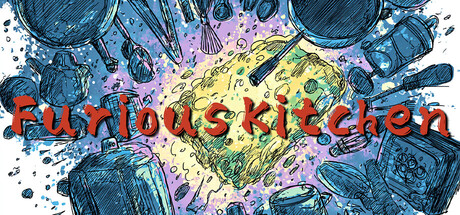
During the development of Furious Kitchen, we utilized generative Artificial Intelligence (AI) tools to assist in content creation and optimization. The specific implementations are as follows:
Programming & Scripts: We used AI programming assistants (Large Language Models) to help write and refactor underlying game logic code, as well as to assist with the implementation of the multi-language localization system and text translation.
Art Assets : Certain visual elements within the game (such as UI icons, background assets, or promotional base art) were created with the assistance of AI image generation tools. All generated images were subsequently redrawn, modified, and stylized manually by the developer to fit the game's aesthetic.
Music & Audio : Some background music or sound effect assets in the game were composed and arranged using AI audio generation tools.
This game does not feature any live-generated AI content (i.e., AI content generated in real-time while playing). All AI-assisted assets were pre-generated during the development phase and carefully reviewed to ensure they do not infringe upon any third-party copyrights.
Some parts of this game were created with the assistance of generative AI tools, including certain visual assets, sounds, and code.
All AI-generated content has been reviewed and modified by the developer to ensure quality and consistency.
This game uses AI-generated imagery for store page assets and marketing materials. Including, capsule art and banner images. AI-generated music was used in the trailer and promotional materials. All in-game content is crated by developer.
Generative AI was used only during development to create part of the pre-generated content. This includes some marketing materials for the store page, part of the 3D models, as well as music and some sound effects. All such content was reviewed, selected, edited, and integrated manually by the developer before release.
The game does not use generative AI at runtime. Story content, gameplay logic, enemy behavior, game balance, and any real-time interaction with the player are created and executed without generative AI.
This game uses AI-assisted tools during development for certain visual and technical elements. All generated content has been manually reviewed, refined, and integrated to ensure a cohesive artistic direction and high-quality player experience.
Of course, we used some artificial intelligence technologies to speed up our business processes and produce higher quality and better-performing games. We used Claude for code development, ChatGPT for visual production, created the game's cover art with ChatGPT, and wrote the game's overall code architecture with the help of Claude. These AIs significantly sped up our work, but absolutely do not think: "the developers produced this game without any hassle, using only a single prompt." This thought is completely wrong. What actually happened was that we gave these AIs some of the tasks we would have done ourselves, and they did them in stages to speed up the process. Even with this setup, it still took 6 months to finish the game.
AI-generated images were used during the concept and reference phase. All final in-game artwork, including card illustrations, backgrounds, UI elements, and promotional materials, was hand-crafted and finalized by the developer.
Generative AI was used to create a few very specific, minor promotional images and texture enhancements. Everything else; including plane textures, sprites, UI, and airport layouts, was entirely hand crafted by a single human developer using free editing tools like GIMP, Canva, PowerPoint, and MSPaint.
AI tools were used during development to help generate select visual assets and concepts. These assets were reviewed, refined, and integrated into the game by the developer to ensure consistency with the overall style and experience.
This game was developed with AI assistance for visual assets, sound effects, localization, and code. All AI-generated content was pre-generated during development and reviewed by the developer. No real-time AI content generation occurs during gameplay.
Generative artificial intelligence was used to create and improve the game's main logo and some marketing materials (store capsules). All other game content, including models, animations, and code, was developed using traditional methods.
Certain visual assets, including the game’s logo and box art, were created with the assistance of AI tools and may have been further refined or edited by the developer
Generative AI was used to assist in the creation of visual assets, such as textures and UI backgrounds. Additionally, in-game text was refined and localized with the help of AI to ensure grammatical accuracy and a natural flow in English
AI-assisted tools were used for all of the game visuals, audio, and code. No AI generation occurs during gameplay, and no external AI services are used while playing.
Empetiti: Quest for the Pinnacle uses generative AI as part of the production pipeline for selected images and voice-over/audio assets appearing in the game and some promotional materials. These assets are reviewed and refined by the development team before being published. The game does not use live-generated AI during gameplay.
THE GAME IS CONSTANTLY BEING REWORKED TO FURTHER MINIMISE THE USE OF AI-GENERATED IMAGES AND VOICES.