Public Steam disclosure research27,951 disclosures tracked
Where do games disclose AI use?
Search developers’ Steam disclosures, compare classified AI use across
games, and follow recorded changes.
This index adds cross-game classifications and statistics to
statements published on individual store pages.
Groups reflect automatic analysis of public disclosures; mature records are excluded. These counts do not measure AI use across all of Steam.
Missing or unclear statements cannot establish whether a game uses AI.
Founders was made with extensive use of generative AI. The program code, game texts, translations, images, store artwork, trailer, music and sound effects were created with AI tools during development. The ideas behind the game come from the developer, who reviewed, selected and tested the results. The game does not generate any content with AI during play and does not send any data to AI services.
FrostHaul was made with the help of generative AI tools. Many 2D images, including item icons, crew portraits, story and event paintings, some textures and the store artwork, were generated with AI image tools and then edited and assembled by the developer. Parts of the game's text and 3D models were also produced with AI assistance under the developer's direction. The trailer's music and voice-over were made with AI music and voice tools. No AI content is generated while you play.
Some content was pre-generated with AI tools and then edited by the developer: part of the 3D models and their textures, art for some in-game arcade and PC games, some text such as fictional artist and record names, and the narration voice and the music of the trailer. The game does not generate any AI content while it runs.
All 3D art and crew voices were made by hand. A few background music tracks and the logo were generated with AI tools, and AI helped draft the translations.
We use generative AI to translate and polish text for the Steam store page and in-game content, and to explore layout options for some marketing materials.
The final visual assets use the developer-created logo and in-game 3D assets. No AI-generated images are used.
The game has no features that use generative AI to generate content during gameplay.
Some store artwork, the character art, parts of the 3D assets, the music and parts of the writing (letters, dialogue and store text) were created with the help of AI tools, then edited and curated by the developer. The translations of the game and the store page into other languages were also made with the help of AI tools and are being reviewed. The game does not generate any content with AI while it is running.
Generative AI tools were used during development to help draft and refine some in-game dialogue, localization, and store description text. No AI-generated content is created during gameplay.
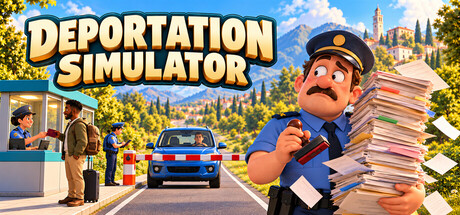
In DEPORTATION SIMULATOR, we use artificial intelligence to enable dynamic and interactive interrogation conversations. Players can ask suspects their own questions using a microphone and receive individually generated AI responses.
AI processing is currently handled primarily by locally hosted AI models running on our own server infrastructure. Depending on server load and available computing resources, we may also use external AI service providers, such as OpenAI, to support these interactions.
Our AI system is undergoing continuous development and improvement. Through regular training, ongoing optimization, and further refinement of our models, we aim to steadily improve the quality, realism, and variety of AI-generated responses. Our goal is to create natural, believable, and context-aware conversations in which the AI can respond dynamically to players' questions and decisions.
In the long term, our goal is to operate entirely on our own locally hosted AI models. We plan to reinvest future revenue from the game into expanding our own server and computing infrastructure, allowing us to gradually reduce our reliance on external AI providers and eventually operate and develop our AI systems independently.
AI is used specifically to support interactive gameplay features, particularly the dynamic conversations and responses during interrogations.
Connects to 3rd-Party Service for AI Content Generation: Eigene Verhör-KI / Own interrogation AI; OpenAI (Fallback)
RenewCity is made by a solo developer using AI-assisted tools. Some written content — including parts of the in-game event text, newspaper headlines, and store page copy — was drafted with AI assistance, then edited and approved by the developer. The simulation design, city data, and game systems are the developer's own work. No AI content is generated while you play.
Mars Gardener was made by one person with the help of AI tools: the code, the 3D models (built by the game's code), the sounds and music (synthesised by the game's code), and the texts in French and English and their translations into 28 other languages, under the author's direction. The screenshots, animations and gameplay video on this page come from the game; the cinematic trailer is staged with the game's own models, made the same way. The game generates nothing with AI while you play.
All characters, buildings, trees, music and sound effects were made by human artists. Generative AI (an LLM) helped with programming, text and translations, including code that draws a few simple background tiles. No AI image generators or AI audio were used.
AI tools were used to polish selected store-page artwork based on in-game screenshots. In-game booking calls use AI text-to-speech to voice developer-written dialogue with changing ride details during gameplay.
Code and all translations were written with the help of AI tools and reviewed by the developer. The art is a purchased, hand-made pixel art pack (antarcticbees). Music and sound effects are synthesized by the developer's own code.
Resortful was built by a solo developer using AI tools. Code: written with Claude Code (an AI coding assistant) from the developer’s designs and prompts, then tested and reviewed by the developer. 3D models, music, and sound in trailers were generated with AI tools (Higgsfield) and selected, edited and placed by the developer. Translations into 13 languages were AI-generated and checked. The game’s concept, design, economy, balance and all creative decisions are the developer’s own. No AI content is generated at runtime.
AI tools were used to assist in producing some 3D models and other assets during development, under the developer's strict direction. No AI generates content while the game is running.
Express Lane uses content made with generative AI. The background music comes from a free (CC0) collection of lofi tracks generated with Suno. The game’s code were written with help from AI tools and reviewed and edited by the developer. The 3D models and characters are made by human artists. No AI generates content while you play.
Some of this game's 2D artwork including the logo and store page images — began as AI-generated images, worked up from reference art we own. Every image is hand-picked by the developer and retouched by hand as needed; nothing ships unseen. The music is AI-generated, created with Suno under a paid licence. Sound effects are royalty-free recordings or created in our in-house studio, not AI-generated. The game does not generate any content while you play — there is no live AI generation of any kind.
This game makes limited use of generative AI. Some of the store page and marketing text was written with AI assistance, and the in-game interface translations (localization) were produced using generative AI tools. All gameplay, art, and audio are created by the developer without the use of generative AI.
The game's and store page's text (dialogue, neighbours' stories, names, descriptions) and its translations were made with generative AI. The 3D models are built by code, and the store images are made from frames of the game. Music, sounds and fonts come from licensed libraries. No AI generates anything while you play.
Generative AI tools were used during development to create some pre-rendered artwork, including menu and interface illustrations and guest portraits, and to assist with localization and store descriptions. These assets and texts are prepared before release. The game does not generate AI content during gameplay or connect to an external AI service.
Made by one person, with the help of generative AI for almost all content. Working together with the AI, I went through hundreds of iterations, fixing and polishing the details until everything felt right. That’s why you get Lost Bitcoin for a lower price.
A small number of in-game art assets were created with the help of generative AI to add flavor, and a small portion of the algorithmic code was written with generative AI assistance. All art assets and code were reviewed and verified by our team before release.
Callback Crew was built with AI assistance in development: AI helped write and debug game code, create UI and some in-game text such as item descriptions and job notes, all directed and reviewed by the developer. Very little AI generated art, audio, music, or voice is used; 3D assets are over 90% licensed Synty packs. The game does not generate any content with AI while you play.
AI Creation Statement:
The places where AI (deepseekV4.1flash) was used in this project are:
Multilingual translation (100%): Apart from the Simplified Chinese text, which the author typed manually, all translations into other languages were completed by AI.
Movie reviews (100%): Characters’ movie reviews.
Script structure optimization (0.5%–1%): Bugs in the code that were difficult to fix were optimized by AI.
Some content was made with the help of generative AI tools and then reviewed and edited by our team:
The key art used for the store capsules, library images and game icon was generated with an AI image tool and then cropped, composed and finished by us. In-game screenshots are real gameplay.
The interface translations (15 languages besides English) were produced with AI assistance.
AI assistants helped write parts of the game’s code and procedural 3D models, and helped draft store text.
The 3D environment and characters are licensed asset packs (Synty Studios), and the interface art is by Kenney (CC0). No AI generates content while the game is running.
Climbing Gym Manager is made by a solo developer. Just one man an idea and a whole heap of experience. I designed the game, built the simulation and chose every asset in it. The screenshots are captured from the game itself.
I used generative AI tools to help speed up my workflow including some of the visual assets. Most were then finished by hand: edited, corrected, recoloured and adjusted to fit the game’s style. The store artwork was also made with AI tools and cleaned up by hand.
The music is a mix of AI-generated tracks and licensed royalty-free music. The interface sounds were made for the game.
AI was used in the creation of this game, and its important to be clear about this as a solo dev.
But every aspect of the game that AI was used as a helper/producer was reviewed by me, and thoroughly edited, tested, reworked, perfected and placed with intention by me.
AI was used to generate assets, code and tools to help me be able to finish this game working as a solo dev.
- Graphics in the game are human-made, however, some of those are color-graded and re-coloured with AI tools.
- All in-game text is proof-read by AI to safeguard against typos and grammar issues.
- Sound and music volume(db) balance, as well as mixer balance, was handled by AI tools.
Generative artificial intelligence has been used as an assistive tool to create the static 2D portraits of the gladiators and the background illustrations for the user interface. All generated assets have been manually supervised, filtered, and edited by the developer to ensure they perfectly fit the historical setting and the visual style of the game.
Generative AI is used during development to assist with some art assets, promotional artwork, and written content. These materials are selected and reviewed by the developer before release.
The music in this game was created with the AI music tool Suno. The game’s visuals were not generated by AI. The game does not generate any content with AI during gameplay.
AI-assisted tools were used during development to create some visual assets, including the toy piano's decorative decal, and to assist with localization. This content is prepared before release; no AI content is generated during play.
Some assets were created with AI tools during development and reviewed and edited by the team: background paintings, character portraits, table and building art, achievement and cosmetic icons, and music, sound effects and the trailer narration. Parts of the in-game writing were drafted with AI and edited by the developer. No generative AI runs while you play.
The developer used generative AI tools during development for C# code, Blender scripts, 3D models and textures, 2D art and illustrations, the opening film and other video, character voice-over, and in-game text. All content was reviewed, edited and tested before release. No content is generated by AI while you play.
Artificial intelligence has been used to translate texts into different languages and optimize existing code.
Note: Some assets are generated in game through code and artificial intelligence was used to help improve this code.
My AI Game Studio uses local generative AI (via Ollama) to power your studio’s employees. Each employee’s personality, skills, and role shape how the AI drives their dialogue, decisions, and work. This includes what they say when you talk to them one-on-one or call a meeting, how they react to changes in the studio, and how they contribute to the game your team is building. The playable game your studio develops, the bug reports you file, your marketing results, and your studio’s growth all change over time based on these AI-driven decisions.
All AI processing runs entirely on the player’s machine. No data is sent to external servers.
Because dialogue is generated live, employees may occasionally say unexpected things. The AI runs with instructions that keep employees in character and on topic, and that restrict inappropriate content.
Generative AI tools were used in the development of this game, including the creation and refinement of some assets and content. All AI-generated content was reviewed, adjusted, and polished by our team.