Public Steam disclosure research27,848 disclosures tracked
Where do games disclose AI use?
Search developers’ Steam disclosures, compare classified AI use across
games, and follow recorded changes.
This index adds cross-game classifications and statistics to
statements published on individual store pages.
Groups reflect automatic analysis of public disclosures; mature records are excluded. These counts do not measure AI use across all of Steam.
Missing or unclear statements cannot establish whether a game uses AI.
Terrors of War is being developed solo on a tight budget. To get the project to its current state I've used generative AI for a handful of placeholder assets: some voice lines, sound effects, UI iconography and the current Steam capsule art. These are all temporary. Every AI-assisted asset is flagged in the project as a placeholder and will be replaced with custom work from freelance artists progressively through Early Access. Wherever possible I use in-game screenshots and footage. What you see represents actual gameplay. No content is generated at runtime. All AI-assisted assets ship pre-generated in the build.
In the development of this game generative AI was used for environment mood boards, 3D model drafts, and soundtrack inspirations. Final in-game assets are all human-curated with purpose and intent.
AI was used to assist with voice modification for certain characters.
AI was used to help with soundtrack enhancement and editing.
AI was used to create or refine some visual symbols and sigil designs.
This game and associated materials uses AI generated audio and visual graphics content. All AI generated content is commercially licensed from the industries leading AI generation platforms.
This game and associated materials uses AI generated audio and visual graphics content. All AI generated content is commercially licensed from the industries leading AI generation platforms.
Generative AI tools were used during the development of Academy: Become a Hero to create and refine several game assets. The disclosure of its use is as follows:
2D Art and User Interface: All 2D illustrations, UI elements, icons, and menus (including upgrade screens, stage selection, and customization menus) were generated using AI tools and subsequently edited and refined for final integration.
3D Modeling: The main character (Troid) and its skeletal meshes were created using Meshy. We hold a valid commercial license for all content generated and used in the project.
Localization: Game localization and translations into all supported languages were performed with the assistance of AI large language models to ensure global accessibility.
Audio and Voiceovers: For the introductory cinematic, AI was utilized to modulate and process the developer's original voice recordings to create distinct and characterized voices for the different characters.
All AI-generated content has been manually reviewed, corrected, and finalized by the developer to ensure artistic consistency and technical quality.
This game and associated materials uses AI generated audio and visual graphics content. All AI generated content is commercially licensed from the industries leading AI generation platforms.
This game and associated materials uses AI generated audio and visual graphics content. All AI generated content is commercially licensed from the industries leading AI generation platforms.
This game and associated materials uses AI generated audio and visual graphics content. All AI generated content is commercially licensed from the industries leading AI generation platforms.
Along with traditional art the game makes use of art assets generated by AI based algorithms. The campaign voice is generated by a licensed AI tool. All AI assets are commercially licensed.
Out of a total of 12 music tracks, 9 were produced using AI. A total of 25 villager profile pictures were generated with AI. All languages except German, French, Polish, Brazilian Portuguese, and Turkish were translated using AI.
AI was used in the creation of the Steam capsule logo.
Generative AI was used to generate a total of 3 silly meme songs/sounds in the game, the most prominent being the title screen music. All other level soundtracks/sfx were otherwise created by a human (shoutout to my lifelong DJ TheMedisin).
Generative AI was used to create part of our steam page logos.
The vast majority of the game is hand crafted. Hand refined and adjusted Midjourney generations have been used for certain ingame graphics.
(Optional)Deepvoice has been used for certain enemy vocal exclamations. Can be changed ingame to human VA only.
I Had A Plan! uses human-made sprites and assets, but uses AI to transform voices for most (non narrator/GM) characters. These were still recorded by the developer, but then transformed to sound like other people using AI. AI was also used to lip sync those voices.
Some translations, voicelines, and assets were made using generative AI. All carefully inspected by the developer.
This is used to speed up the development, and is being slowly replaced with artists authored assets.
No generative AI is used during gameplay.
We have sections that use AI:
1. On the character selection page of the game, the character's voiceover is created by AI
2. On the character selection page of the game, the first version of the character's sketch is created by AI.
Illustrations in the game's "event" system are created by AI.
The game is a research project into how the use of AI would affect game production, so AI has been used for images, voiceovers, code, dialogue and other areas as much as possible. Just to see what sort of results it provides.
The game includes some temporary AI-generated content (such as images, sounds, or graphical elements) used solely to speed up the development process. All of these assets are provisional and will be progressively replaced with original materials as the project advances.
Some music and graphical elements (ie. music that plays during scenes, pictures that display during scenes, etc.) were edited and/or created using AI. These technologies are used sparsely throughout the game, and the entirety of Cryspace's story, characters, UI elements, etc. were not created using any AI technologies.
DeepL has been used as a tool for aiding the translations, AI has been used for image generation (a complete list can be found in-game), a single song is AI-generated song (can you spot it? ;) It has been exclusively added for the Steam release. In a recent update, we also added optional AI-background music for a part of the game.
I (Creekside Interactive) use AI generated music via SUNO. In which I (Creekside Interactive) own all the rights to song(s) generated by SUNO as stated in the SUNO commercial license purchased by Levi's Arts LLC.
We generated drafts for the game's and company logos, part of the capsules art, the voice in the trailer and the store texts. Then we adapted them to our liking.
Text-to-speech software is used to synthesize our in-game and in-cinematic robotic announcer. RIFTSTORM’s creative direction and all content included in the game are produced, reviewed, and implemented by our team.
The AI integrated into Mental creates a dynamic experience by automatically generating text, textures, sound, lighting, and gameplay mechanics. Each session offers unique stories, customized visual environments, and challenges adapted in real-time to your actions, ensuring a consistently fresh and immersive adventure.
Some background and character art extended and enhanced using Photoshop generative fill. Some audio help narration done using an in-house cloned voice for clarity. Some audio narration done using professionally licensed cloned voice.
Two profile pictures (one of these designs is also used as a decal on a tool), all of the "records" in the main characters room, designs on the vape packaging, and a background image for a vending machine were created with Adobe Generative Fill.
The Security Robots and The Coffee Time video use audio generated by TTS Maker.
The TOS was templated with AI as a generic TOS and meaningful elements were edited in. The Coffee Drink descriptions are pure, unfiltered, AI corpo-garbage-text.
I used AI for these purposes because the uncanny-valley, soulless, style was exactly what I wanted as an art direction. I wanted to depict a future in which the soul of the world has been killed by AI. Making humans create art in the style of AI sounds completely dehumanizing, but you're entitled to your opinion.
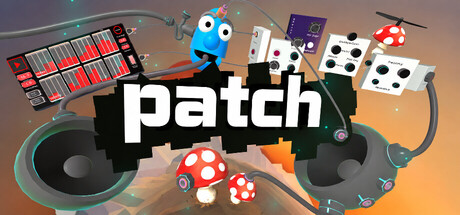
PatchWorld includes optional generative AI tools that players can use to create custom content for their worlds and devices.
Players can generate images, 360° skyboxes, 3D meshes, and audio samples by entering text prompts using in-game tools such as the GenieBox device or scripting blocks. Each generation is initiated directly by the player and takes a short amount of time to complete.
Generated content can be used to decorate worlds, create sound effects, and build custom musical instruments. By default, all generated content remains private to the creator and is only shared with others if the player chooses to publish their world.
Generative AI features are entirely optional and are designed to support creativity, experimentation, and collaborative world-building.