Public Steam disclosure research25,497 disclosures tracked
Where do games disclose AI use?
Search developers’ Steam disclosures, compare classified AI use across
games, and follow recorded changes.
This index adds cross-game classifications and statistics to
statements published on individual store pages.
Groups reflect automatic analysis of public disclosures; mature records are excluded. These counts do not measure AI use across all of Steam.
Missing or unclear statements cannot establish whether a game uses AI.
AI tools were used during development for prototyping, text correction, and translation support.
No AI-generated images or assets are present in the final game or on the store page.
All visual and gameplay content is original and created by the developer.
Some promotional images and parts of the in-game text translations were created with the help of AI tools, but all content was reviewed and finalized by the development team.
This game was created with the help of AI tools to assist in areas such as translation, and development support. All creative decisions were made by the human developer.
In the early stages of development, localization uses a mix of AI-assisted translation and human review out of necessity. The shift to full human localization is planned the moment the project can support it.
Use AI-generated images and convert them into paintings to use as concept art for the main menu and in-game simulated advertising images.
Use AI to create images for in-game currency.
Use ChatGPT to create lyrics for the theme song.
Some questions and answers in our quiz game are generated using AI. Additionally, we utilized pre-generated AI images included in the capsules and for in-game assets, specifically for the game characters.
This game was written and designed by humans. Generative AI was only used as a support tool, such as checking language, streamlining text, and optimizing visuals. All creative choices and content come from the developer.
The following localizations (in-game and store page) are created with the assist of generative artificial intelligence:
- French
- German
- Japanese
- Korean
- Portuguese (Brazil)
- Russian
- Spanish
The logo for the game studio "Dumen Games" is created with the assist of generative artificial intelligence.
AI is used to power the in-game assistant character, providing dynamic dialogue and context-aware guidance during gameplay. The AI generates helpful hints, tutorial information, and gameplay tips based on your current situation. All AI-generated content is limited to gameplay assistance only and cannot produce inappropriate or copyrighted material.
Character voices are synthesized with the Voice Synthesizer VOICEVOX, and the Japanese translation is provided by the machine translator DeepL. Neither of these uses generate content in real-time. No sprites, code, ideas, music, or any other elements not mentioned were made with AI.
We used AI to generate spotter phrases based upon the voices of real-life NASCAR spotters, with their approval. We also used AI to generate crew member photos.
Because this game was developed and produced by an individual with limited energy, some icons and story texts were generated with the assistance of AI and were manually screened and polished to improve the overall game quality and player experience.
Our game uses AI to create dynamic NPC dialogues based on player prompts.
All inputs are filtered by OpenAI’s moderation model, and generated content stays inside the game.
Some graphical content in the game was generated using AI tools. Additionally, some translations were created with the help of AI. We will provide tools for players to suggest improvements, ensuring the best possible experience for everyone.
This game uses AI-generated content created with ChatGPT and Bing Image Creator. AI was used to help write store page text, promotional material, and generate some illustrative images. No AI is used in the game's real-time execution or gameplay code.
Pal Engine offers an optional AI chat powered by Google Gemini, letting your 3D desktop companion respond with personalized, real-time conversations. Each character has its own personality and memory, creating unique interactions. Built-in content filters block harmful or copyrighted outputs.
AI-Generated Content Disclosure
I am a solo developer with no programming background. Before using AI, I spent three months following YouTube tutorials, deleted everything and restarted three times, and typed every line of code myself until the foundation of this game clicked.
From there, I used AI — primarily Claude — as a teacher and debugging partner across 7,000+ conversations over 16 months to learn GDScript and build every system in the game. The first line in my prompts is always "Stop being a yes sayer and always be brutal and honest."
Here is exactly what AI was and wasn't used for:
Code: I spent my first three months writing every line of code by hand. As the project grew, AI became a development partner — drafting code from my descriptions, which I then reviewed, debugged, and integrated. AI taught me programming concepts and helped me solve problems. Every design decision and system architecture is mine.
Art: AI-generated with extensive human direction and manual editing. Some pieces required 15 pages of descriptions. I often assemble final art from multiple elements — finding references, combining parts, and making hands-on edits until it matches my vision.
Animation: The first 14 enemies and 2 bosses were animated by me personally in DragonBones. For newer content, I'm exploring AI-generated animations and working to make them feel personal and consistent with the game's style — you can see examples with the later bosses. Some of these I'm still not satisfied with and will redo, which is just part of the process.
Music: I produced 350+ tracks using AI music tools and curated the best for the game. All creative direction — mood, style, placement — is mine.
Writing: All card text, lore, descriptions, and UI text are written by me. AI occasionally helps with polish.
Game Design: Every mechanic, card interaction, and balance decision comes from a lifetime of gaming — hundreds of board games, decades of Magic: The Gathering, a career at Blizzard Entertainment, and more consoles than most people can count. AI does not design games. That part is entirely human.
EDIT1: I felt the need to mention that I got diagnosed with ADHD last year, at the age of 47. The reason I could never learn coding in a traditional way is my attention span. If I am not interested it is super hard, and if I am interested it is super awesome. I get excited when I can talk and describe how I want my game to feel and function. The AI converts that to code, and together we've created a way for me to follow my dream and make a game that I want to play. I have thought to myself many times during development that I wish I knew how to make this myself, and I wish I was able to just learn and do things like most people. But here we are.
"EDIT2: I updated the Code section to be more precise. I only wrote code entirely by hand for the first three months. After that, AI and I worked together — I designed and described what I needed in detail, AI drafted it, and I reviewed, debugged, and integrated everything."
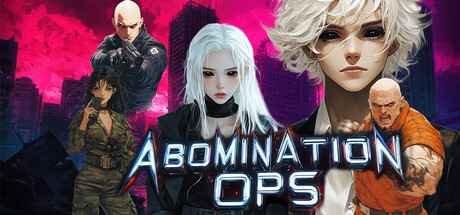
AI was used to create the visual art, music, voices, and sound effects. Abomination Ops was developed to demonstrate how modern artificial intelligence tools can be harnessed to craft a fully cinematic experience accessible to everyone. The story, world, and characters were conceived and written by a human being.
Sketch Play includes an in-game assistant called Scholia. When you ask her to look at a page, she reads your drawing and writes back her impressions, a few things to try next, and an experience-point reward. That written feedback is generated by Gemma 4 E2B, a small open-weights AI model.
Scholia cannot draw. She has no ability to generate images, alter your artwork, or add anything to the page. Everything in your sketchbook is drawn by you and the people you invite.
The model runs entirely on your own computer. No account or internet connection is required, nothing you draw is uploaded, and none of your work is used to train anything.
Her notes are one opinion, and she has biases.
This game uses generative AI to create real-time in-game content such as character dialogue and ambient sound. All AI-generated content is moderated and filtered to prevent inappropriate or infringing material. Players can report content directly through in-game tools or the Steam interface.
Artificial intelligence was used to pre-generate texts about objects (e.g. dinosaurs), assist in building the shop page, and create a few AI-generated images in the game.
AI was utilized to generate portions of the game's text, 3D models, textures, and code. These elements were subsequently edited and finalized by the developer.
AI has been utilized during the store page assets creation of this game. We have used it for the game icon creation, correcting some of the explanation texts about the game mechanics to have a clear communication with our players.
AI tools were used to create some videos, paint characters, scenarios and weapons, as well as to correct texts and help identify difficult bugs. All AI-generated material was manually reviewed to ensure quality and consistency with the project.
In the game, AI generates text responses in real time in response to a user's conversation input. Players can naturally communicate with characters on the screen, where the Generative AI analyzes the user's input and generates responses. Some features also provide personalized interactions by generating in-game settings, mood swings, and advice messages in real time.
Character portraits, item images, and visual assets are generated using AI image creation tools
Some narrative content, including mission descriptions and flavor text, incorporates AI-assisted writing to enhance storytelling depth and variety
Real-Time Generation: All content is created dynamically during gameplay. It is not a copy of existing works, but rather a spontaneous reaction to player actions—similar to improvisation.
Some art, dialogue polish, and marketing copy were developed with the help of AI tools. No content is live-generated during gameplay. All AI-assisted material was manually reviewed, edited, and integrated with original work.
AI tools were used during development for prototyping, text correction, and translation support.
No AI-generated images or assets are present in the final game or on the store page.
All visual and gameplay content is original and created by the developer.
Some promotional images and parts of the in-game text translations were created with the help of AI tools, but all content was reviewed and finalized by the development team.
This game was created with the help of AI tools to assist in areas such as translation, and development support. All creative decisions were made by the human developer.
In the early stages of development, localization uses a mix of AI-assisted translation and human review out of necessity. The shift to full human localization is planned the moment the project can support it.
Use AI-generated images and convert them into paintings to use as concept art for the main menu and in-game simulated advertising images.
Use AI to create images for in-game currency.
Use ChatGPT to create lyrics for the theme song.
Some questions and answers in our quiz game are generated using AI. Additionally, we utilized pre-generated AI images included in the capsules and for in-game assets, specifically for the game characters.
This game was written and designed by humans. Generative AI was only used as a support tool, such as checking language, streamlining text, and optimizing visuals. All creative choices and content come from the developer.
The following localizations (in-game and store page) are created with the assist of generative artificial intelligence:
- French
- German
- Japanese
- Korean
- Portuguese (Brazil)
- Russian
- Spanish
The logo for the game studio "Dumen Games" is created with the assist of generative artificial intelligence.
AI is used to power the in-game assistant character, providing dynamic dialogue and context-aware guidance during gameplay. The AI generates helpful hints, tutorial information, and gameplay tips based on your current situation. All AI-generated content is limited to gameplay assistance only and cannot produce inappropriate or copyrighted material.
Character voices are synthesized with the Voice Synthesizer VOICEVOX, and the Japanese translation is provided by the machine translator DeepL. Neither of these uses generate content in real-time. No sprites, code, ideas, music, or any other elements not mentioned were made with AI.
We used AI to generate spotter phrases based upon the voices of real-life NASCAR spotters, with their approval. We also used AI to generate crew member photos.
Because this game was developed and produced by an individual with limited energy, some icons and story texts were generated with the assistance of AI and were manually screened and polished to improve the overall game quality and player experience.
Our game uses AI to create dynamic NPC dialogues based on player prompts.
All inputs are filtered by OpenAI’s moderation model, and generated content stays inside the game.
Some graphical content in the game was generated using AI tools. Additionally, some translations were created with the help of AI. We will provide tools for players to suggest improvements, ensuring the best possible experience for everyone.
This game uses AI-generated content created with ChatGPT and Bing Image Creator. AI was used to help write store page text, promotional material, and generate some illustrative images. No AI is used in the game's real-time execution or gameplay code.
Pal Engine offers an optional AI chat powered by Google Gemini, letting your 3D desktop companion respond with personalized, real-time conversations. Each character has its own personality and memory, creating unique interactions. Built-in content filters block harmful or copyrighted outputs.
AI-Generated Content Disclosure
I am a solo developer with no programming background. Before using AI, I spent three months following YouTube tutorials, deleted everything and restarted three times, and typed every line of code myself until the foundation of this game clicked.
From there, I used AI — primarily Claude — as a teacher and debugging partner across 7,000+ conversations over 16 months to learn GDScript and build every system in the game. The first line in my prompts is always "Stop being a yes sayer and always be brutal and honest."
Here is exactly what AI was and wasn't used for:
Code: I spent my first three months writing every line of code by hand. As the project grew, AI became a development partner — drafting code from my descriptions, which I then reviewed, debugged, and integrated. AI taught me programming concepts and helped me solve problems. Every design decision and system architecture is mine.
Art: AI-generated with extensive human direction and manual editing. Some pieces required 15 pages of descriptions. I often assemble final art from multiple elements — finding references, combining parts, and making hands-on edits until it matches my vision.
Animation: The first 14 enemies and 2 bosses were animated by me personally in DragonBones. For newer content, I'm exploring AI-generated animations and working to make them feel personal and consistent with the game's style — you can see examples with the later bosses. Some of these I'm still not satisfied with and will redo, which is just part of the process.
Music: I produced 350+ tracks using AI music tools and curated the best for the game. All creative direction — mood, style, placement — is mine.
Writing: All card text, lore, descriptions, and UI text are written by me. AI occasionally helps with polish.
Game Design: Every mechanic, card interaction, and balance decision comes from a lifetime of gaming — hundreds of board games, decades of Magic: The Gathering, a career at Blizzard Entertainment, and more consoles than most people can count. AI does not design games. That part is entirely human.
EDIT1: I felt the need to mention that I got diagnosed with ADHD last year, at the age of 47. The reason I could never learn coding in a traditional way is my attention span. If I am not interested it is super hard, and if I am interested it is super awesome. I get excited when I can talk and describe how I want my game to feel and function. The AI converts that to code, and together we've created a way for me to follow my dream and make a game that I want to play. I have thought to myself many times during development that I wish I knew how to make this myself, and I wish I was able to just learn and do things like most people. But here we are.
"EDIT2: I updated the Code section to be more precise. I only wrote code entirely by hand for the first three months. After that, AI and I worked together — I designed and described what I needed in detail, AI drafted it, and I reviewed, debugged, and integrated everything."
AI was used to create the visual art, music, voices, and sound effects. Abomination Ops was developed to demonstrate how modern artificial intelligence tools can be harnessed to craft a fully cinematic experience accessible to everyone. The story, world, and characters were conceived and written by a human being.
Sketch Play includes an in-game assistant called Scholia. When you ask her to look at a page, she reads your drawing and writes back her impressions, a few things to try next, and an experience-point reward. That written feedback is generated by Gemma 4 E2B, a small open-weights AI model.
Scholia cannot draw. She has no ability to generate images, alter your artwork, or add anything to the page. Everything in your sketchbook is drawn by you and the people you invite.
The model runs entirely on your own computer. No account or internet connection is required, nothing you draw is uploaded, and none of your work is used to train anything.
Her notes are one opinion, and she has biases.
This game uses generative AI to create real-time in-game content such as character dialogue and ambient sound. All AI-generated content is moderated and filtered to prevent inappropriate or infringing material. Players can report content directly through in-game tools or the Steam interface.
Artificial intelligence was used to pre-generate texts about objects (e.g. dinosaurs), assist in building the shop page, and create a few AI-generated images in the game.
AI was utilized to generate portions of the game's text, 3D models, textures, and code. These elements were subsequently edited and finalized by the developer.
AI has been utilized during the store page assets creation of this game. We have used it for the game icon creation, correcting some of the explanation texts about the game mechanics to have a clear communication with our players.
AI tools were used to create some videos, paint characters, scenarios and weapons, as well as to correct texts and help identify difficult bugs. All AI-generated material was manually reviewed to ensure quality and consistency with the project.
In the game, AI generates text responses in real time in response to a user's conversation input. Players can naturally communicate with characters on the screen, where the Generative AI analyzes the user's input and generates responses. Some features also provide personalized interactions by generating in-game settings, mood swings, and advice messages in real time.
Character portraits, item images, and visual assets are generated using AI image creation tools
Some narrative content, including mission descriptions and flavor text, incorporates AI-assisted writing to enhance storytelling depth and variety
Real-Time Generation: All content is created dynamically during gameplay. It is not a copy of existing works, but rather a spontaneous reaction to player actions—similar to improvisation.
Some art, dialogue polish, and marketing copy were developed with the help of AI tools. No content is live-generated during gameplay. All AI-assisted material was manually reviewed, edited, and integrated with original work.