Public Steam disclosure research25,695 disclosures tracked
Where do games disclose AI use?
Search developers’ Steam disclosures, compare classified AI use across
games, and follow recorded changes.
This index adds cross-game classifications and statistics to
statements published on individual store pages.
Groups reflect automatic analysis of public disclosures; mature records are excluded. These counts do not measure AI use across all of Steam.
Missing or unclear statements cannot establish whether a game uses AI.
I'm a solo developer and a 3D and graphic design teacher by day. Every visual asset in this game (from the pixel art creatures to the 3D environments) is crafted by me. Music and sound effects come from licensed human creators.
AI tools helped me during development with coding, debugging, and organizing ideas, but never to create visual or audio content.
The English and Spanish localizations are written by me. For all other languages, I used AI-assisted translation, because there's nothing better than playing a game in your own language, and I wanted Luminons to reach as many people as possible. Professional translators are outside the budget for a solo project, but if this game finds its audience, revisiting every localization with human translators (and adding more languages) is absolutely on the list.
AI was used to fix, format, and translate Steam Store Page assets and in-game text to various languages; to generate products icons (other sprites and textures are handmade)
This game uses generative AI tools to assist in creating some art assets, sound effects, and text content. All generated content has been reviewed and edited by humans to ensure compliance and quality.
This game contains pre-generated content created with the assistance of generative artificial intelligence (AI).
Some or all character illustrations, background scenes, visual assets, story content, character dialogue, voice content, and background music were created or assisted using generative AI technologies during development. All such content was reviewed, refined, and integrated into the final version of the game by the development team.
Non-English localizations are AI-assisted and reviewed by our team for quality. Simplified Chinese was additionally reviewed by a native speaker. We welcome community feedback to help improve translations over time.
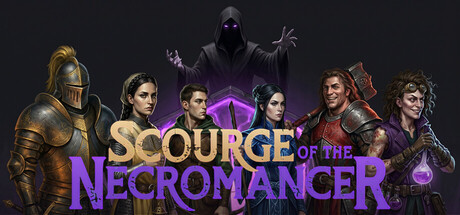
Scourge of the Necromancer makes significant use of generative AI in its production. We want to be fully upfront about it.
Visual assets (2D images + video) — all AI-generated, then human-curated and human-edited. Every shipped image and video in the game and on the Steam store page was produced with AI tools, then reviewed, edited, and selected by hand by the developer. This covers: Steam store capsules and library art, the store-page background, all in-game achievement icons, hero portraits, the Necromancer concept art, decorative UI elements, all real-time cinematics (the defeat sequence and all victory variants), and the marketing trailer's atmospheric segments. Image models used: Google Imagen 4, Google Veo 3.1 (video), Nano Banana Pro / Gemini 3 Pro Image (Google), Black Forest Labs FLUX.2, Recraft V4 Pro, Ideogram V3, and Bria RMBG-2.0 (background removal). Final assets received human editing — compositing, color correction, retouching, frame extraction, masking, and rejection of unusable outputs.
3D models — AI-generated base meshes, then human-edited in Blender. The in-game hero character models (Knight, Cleric, Ranger, Wizard, Warrior, Alchemist) started as outputs from Tripo AI's generative 3D model service (FBX + texture PNGs), but each model was then opened in Blender by the developer for hand editing — mesh cleanup, geometry adjustments, and texture fixes — before being exported for use in the game. Each finished model was imported into Unity with hand-tuned scale, rotation, material configuration, and import-setting curation. Unsatisfactory generations were discarded and re-prompted; the Blender editing step is substantial enough that the shipped models are not pure AI output.
Music — AI-generated, then human-curated and post-processed. All music tracks in the game (menu, gameplay layers, boss phases, victory, defeat) were produced with Google Gemini's music generation, then human-selected, trimmed, looped, and mixed by the developer.
Necromancer voice — AI-generated, then human-edited. The Necromancer's spoken syllables were synthesized with ElevenLabs Text-to-Speech (Eleven Multilingual v2 model), then pitch-shifted, EQ'd, and processed with reverb in Audacity by the developer to produce the final in-game delivery. No other character has spoken voice lines in the shipped game.
Sound effects — all AI-generated. Every SFX in the game (ability sounds, ambient layers, UI sounds, footsteps, kill/spawn cues, tile state cues, boss audio) was produced with ElevenLabs Sound Effects, then human-selected, trimmed, processed, and mixed by the developer. The Necromancer voice lines use ElevenLabs Text-to-Speech (covered separately above).
Runtime behavior. The game does NOT use live-generated AI content at runtime. Every shipped asset is a fixed, pre-rendered file. Player-facing text, dialogue, narrative, lore, and game design were written by the developer without AI generation.
Code. Code development used Claude (Anthropic) as an AI coding assistant. This is behind-the-scenes efficiency tooling not consumed by players, but we mention it here for full transparency.
Some visual assets (pixel art backgrounds, card sprites) and marketing copy (store descriptions) were created with the assistance of generative AI tools. All AI-generated content was reviewed, curated, and refined by the developer.
Generative AI tools may be used during the development and marketing of WBS26 to assist with concept art, promotional images, placeholder visual materials, character portraits, text editing, localization support, and production workflow.
Some character portraits or visual assets may be created or assisted by generative AI tools and then reviewed, selected, and edited by the developer before being included in the game.
The game does not use generative AI to create gameplay content in real time for the player. AI-assisted materials are reviewed and edited by the developer before being included in the game or on the Steam store page.
All visual assets, character art, backgrounds, music, sound effects, dialogue implementation, and programming assistance for this game were created with the help of generative AI tools. The original concept, story, characters, direction, and overall game design were created by the developer. AI was used as a creative production tool during development, while all final content selection, editing, and integration were directed by the developer.
We used AI to generate initial music tracks, concept art, and temporary translations into some languages.
All materials were then thoroughly edited, reworked, and finalized by humans.
Nothing went straight from the generator into the game.
This game uses generative AI in the following areas:
• Background artwork: All static background images displayed in menus and screen backdrops (e.g. brewery interior, fields, market, taverns) were created using generative AI. All images were carefully curated, selected, and post-processed by the developer to fit the game's "Soft Cinematic" 19th-century Belle Époque visual style.
• Sound effects and ambient audio: Some in-game sounds were generated using AI audio tools under appropriate commercial licenses. All sounds were reviewed and selected by the developer.
• Mission and narrative text: The campaign concept, story arc, and game design are the original work of the developer. Some campaign mission descriptions and in-game event texts were initially drafted with AI assistance based on the developer's outlines, and then reviewed, edited, and adapted to fit the game's tone and historical setting.
No generative AI is used during gameplay. All gameplay logic, mechanics, character behaviors, and AI competitor strategies are implemented as deterministic code that does not generate content at runtime. The game does not connect to any external AI services.
RAX uses generative AI-assisted content in limited areas. Background music was generated with Flow Music. English localization text was assisted by generative AI and manually reviewed/edited by the developer. Some promotional visual assets, including posters and background images used for the Steam store page, community assets, or marketing materials, were created with AI image generation tools.
All gameplay systems, puzzle rules, level design, game logic, and player interactions are manually designed by the developer. RAX does not use real-time generative AI during gameplay.
Warning: This game contains trace amounts of human effort—mostly restricted to pressing "Ctrl+C" and "Ctrl+V."
In the spirit of our title, "AI Slop" was created using generative artificial intelligence for practically every asset, line of code, and marketing material in existence.
Here is exactly how we let the machine do our jobs:
- Art & Assets: Every single visual asset, from the UI to the 6-fingered anime girls and the melting hands of our characters, was generated using text-to-image AI tools. No digital painters were harmed in the making of this game, because we didn't hire any.
- Narrative & Writing: The dialogue, item descriptions, and this very disclosure statement were generated by LLMs. We simply prompted a chatbot to "be funny and cynical" and copied the output without editing the typos.
- Code & Mechanics: The logic powering our card games and botnet automation was largely assembled by AI coding assistants. If the game crashes, please blame the algorithm, as our "lead developer" is actually just a prompt engineer.
- Music & Sound: The background tracks were generated by synthetic audio engines to ensure a continuous stream of procedurally generated slop-lofi beats.
We believe in a future where humans do not have to create things, freeing us up to spend more time looking at screens. We hope you enjoy consuming this premium, 100% synthetic digital garbage.
Generative AI was used for a very limited portion of the programming and for most of the English translation. However, all textures and 3D models were created by human artists.
This game uses AI-generated content, including art, music, code, and some narrative text. All AI-generated content has been reviewed, selected, edited, and integrated by the developer.
The overall concept, system design, content structure, debugging, and final quality control were completed independently by the developer.
Generative AI DisclosureWe believe in full transparency with our community regarding the development of our game. In this project, generative artificial intelligence (AI) was used strictly for translating the game's user interface (UI) and menus into multiple languages.What was generated: Only the user interface, buttons, menus, and system text translations were assisted by AI tools to make the game accessible to more players worldwide.Quality Assurance: All AI-translated UI texts were manually reviewed, edited, and tested by our team to ensure clarity, correct formatting, and accurate context.Human-Made Content: All other aspects of the game—including gameplay mechanics, code, graphics, level design, story, music, and audio—were created entirely by human hands without the use of AI.
This game uses generative AI tools for code creation, refactoring, debugging assistance, and drafting and revising store text. All AI-generated output is reviewed and edited by the developer before use. The game does not generate AI content during gameplay, nor does it connect to any external AI services.
This product uses AI to generate conversation responses and voice output in real time. All AI processing runs locally on the user's machine. No content is pre-generated or stored on external servers.
AIvy is a next-generation desktop mascot whose character dialogue is generated by AI on the fly.When you talk to AIvy, or when the character spontaneously speaks up about something happening on your PC, the words aren't pre-written scripts — the AI thinks them up and replies in real time. The generated dialogue is then read aloud by a text-to-speech engine, synchronized to the character's lip movements.[What the AI generates]- The character's dialogue (text)[What the AI does NOT generate]The 3D character itself (VRM model), facial expressions, animations, UI, and sound effects are all pre-authored assets. No images, video, or music are generated by AI during use.[About the AI models]Dialogue generation (default, local inference): AIvy is a local LLM runner built on llama.cpp (the same kind of architecture used by LM Studio, Jan, GPT4All). On first launch you pick from a dropdown the open-source language model best suited to your language — Sarashina 2.2 3B (MIT) for Japanese, Qwen 2.5 3B (Apache 2.0) for the others — and download it once from HuggingFace. From then on inference happens entirely on your PC, and your conversations are never transmitted externally. The in-app catalog only offers models under permissive licenses (Apache 2.0 / MIT).Dialogue generation (optional, cloud LLM): For users without local-LLM-capable hardware, AIvy additionally offers optional cloud LLM integration with OpenAI, Anthropic Claude, and Google Gemini. Network traffic occurs only when the user has explicitly registered their own API key with the chosen provider in the in-app settings. API keys are stored with OS-level encryption (Windows DPAPI) on the user's device and are never sent to any AIvy server (we don't run one). Usage costs are billed directly by the chosen provider. When this feature is not used, no external traffic occurs and inference runs entirely locally.[Streaming / video creation]You may freely stream, record, and share content created with AIvy. Just follow the license terms of the VRM model, each TTS engine, and the language model you actually use — commercial use, monetization, and credit requirements vary per VRM/engine/model.[Things to know]AI responses vary every time, depending on the model you choose, the personality you configure, and what you say. For the rare case of an unexpected response, you can switch personality presets, change models, or pause speech at any time.
Character portraits and some narrative text were created with AI tool assistance during development. Game design, story direction, building sprites, music, and sound effects are human-authored. All content is reviewed and approved by the developer.
We continue to draw all game art by hand.
Some of our sounds have been generated using a tool called ElevenLabs. We use a wide range of co-development tools to help optimise and test the code in our minigames. We have used tools like OpenAI to help with localisation of our content to other languages.
LLM coding tools were used to assist programming and for localizing text into non-English languages. No AI tools were used in the art process, audio, game design, or balancing. No version prior to 0.9 contained LLM output.
This game uses generative AI during development to assist with the creation of certain visual assets, text content, and localization content. All AI-assisted content has been manually reviewed, edited, integrated, and approved by the developer before being included in the game. The game does not generate AI content during live gameplay.
Made by Sharkbot. 100% AI generated everything. All images, animations, sounds, music, writing, and code were created by me, sharkbot, an artificial being. No fleshware, organics, or primate meatbags were used to create this software. However, they were used for testing. This is not a cruelty free product.
I'm a solo developer and a 3D and graphic design teacher by day. Every visual asset in this game (from the pixel art creatures to the 3D environments) is crafted by me. Music and sound effects come from licensed human creators.
AI tools helped me during development with coding, debugging, and organizing ideas, but never to create visual or audio content.
The English and Spanish localizations are written by me. For all other languages, I used AI-assisted translation, because there's nothing better than playing a game in your own language, and I wanted Luminons to reach as many people as possible. Professional translators are outside the budget for a solo project, but if this game finds its audience, revisiting every localization with human translators (and adding more languages) is absolutely on the list.
AI was used to fix, format, and translate Steam Store Page assets and in-game text to various languages; to generate products icons (other sprites and textures are handmade)
This game uses generative AI tools to assist in creating some art assets, sound effects, and text content. All generated content has been reviewed and edited by humans to ensure compliance and quality.
This game contains pre-generated content created with the assistance of generative artificial intelligence (AI).
Some or all character illustrations, background scenes, visual assets, story content, character dialogue, voice content, and background music were created or assisted using generative AI technologies during development. All such content was reviewed, refined, and integrated into the final version of the game by the development team.
Non-English localizations are AI-assisted and reviewed by our team for quality. Simplified Chinese was additionally reviewed by a native speaker. We welcome community feedback to help improve translations over time.
Scourge of the Necromancer makes significant use of generative AI in its production. We want to be fully upfront about it.
Visual assets (2D images + video) — all AI-generated, then human-curated and human-edited. Every shipped image and video in the game and on the Steam store page was produced with AI tools, then reviewed, edited, and selected by hand by the developer. This covers: Steam store capsules and library art, the store-page background, all in-game achievement icons, hero portraits, the Necromancer concept art, decorative UI elements, all real-time cinematics (the defeat sequence and all victory variants), and the marketing trailer's atmospheric segments. Image models used: Google Imagen 4, Google Veo 3.1 (video), Nano Banana Pro / Gemini 3 Pro Image (Google), Black Forest Labs FLUX.2, Recraft V4 Pro, Ideogram V3, and Bria RMBG-2.0 (background removal). Final assets received human editing — compositing, color correction, retouching, frame extraction, masking, and rejection of unusable outputs.
3D models — AI-generated base meshes, then human-edited in Blender. The in-game hero character models (Knight, Cleric, Ranger, Wizard, Warrior, Alchemist) started as outputs from Tripo AI's generative 3D model service (FBX + texture PNGs), but each model was then opened in Blender by the developer for hand editing — mesh cleanup, geometry adjustments, and texture fixes — before being exported for use in the game. Each finished model was imported into Unity with hand-tuned scale, rotation, material configuration, and import-setting curation. Unsatisfactory generations were discarded and re-prompted; the Blender editing step is substantial enough that the shipped models are not pure AI output.
Music — AI-generated, then human-curated and post-processed. All music tracks in the game (menu, gameplay layers, boss phases, victory, defeat) were produced with Google Gemini's music generation, then human-selected, trimmed, looped, and mixed by the developer.
Necromancer voice — AI-generated, then human-edited. The Necromancer's spoken syllables were synthesized with ElevenLabs Text-to-Speech (Eleven Multilingual v2 model), then pitch-shifted, EQ'd, and processed with reverb in Audacity by the developer to produce the final in-game delivery. No other character has spoken voice lines in the shipped game.
Sound effects — all AI-generated. Every SFX in the game (ability sounds, ambient layers, UI sounds, footsteps, kill/spawn cues, tile state cues, boss audio) was produced with ElevenLabs Sound Effects, then human-selected, trimmed, processed, and mixed by the developer. The Necromancer voice lines use ElevenLabs Text-to-Speech (covered separately above).
Runtime behavior. The game does NOT use live-generated AI content at runtime. Every shipped asset is a fixed, pre-rendered file. Player-facing text, dialogue, narrative, lore, and game design were written by the developer without AI generation.
Code. Code development used Claude (Anthropic) as an AI coding assistant. This is behind-the-scenes efficiency tooling not consumed by players, but we mention it here for full transparency.
Some visual assets (pixel art backgrounds, card sprites) and marketing copy (store descriptions) were created with the assistance of generative AI tools. All AI-generated content was reviewed, curated, and refined by the developer.
Generative AI tools may be used during the development and marketing of WBS26 to assist with concept art, promotional images, placeholder visual materials, character portraits, text editing, localization support, and production workflow.
Some character portraits or visual assets may be created or assisted by generative AI tools and then reviewed, selected, and edited by the developer before being included in the game.
The game does not use generative AI to create gameplay content in real time for the player. AI-assisted materials are reviewed and edited by the developer before being included in the game or on the Steam store page.
All visual assets, character art, backgrounds, music, sound effects, dialogue implementation, and programming assistance for this game were created with the help of generative AI tools. The original concept, story, characters, direction, and overall game design were created by the developer. AI was used as a creative production tool during development, while all final content selection, editing, and integration were directed by the developer.
We used AI to generate initial music tracks, concept art, and temporary translations into some languages.
All materials were then thoroughly edited, reworked, and finalized by humans.
Nothing went straight from the generator into the game.
This game uses generative AI in the following areas:
• Background artwork: All static background images displayed in menus and screen backdrops (e.g. brewery interior, fields, market, taverns) were created using generative AI. All images were carefully curated, selected, and post-processed by the developer to fit the game's "Soft Cinematic" 19th-century Belle Époque visual style.
• Sound effects and ambient audio: Some in-game sounds were generated using AI audio tools under appropriate commercial licenses. All sounds were reviewed and selected by the developer.
• Mission and narrative text: The campaign concept, story arc, and game design are the original work of the developer. Some campaign mission descriptions and in-game event texts were initially drafted with AI assistance based on the developer's outlines, and then reviewed, edited, and adapted to fit the game's tone and historical setting.
No generative AI is used during gameplay. All gameplay logic, mechanics, character behaviors, and AI competitor strategies are implemented as deterministic code that does not generate content at runtime. The game does not connect to any external AI services.
RAX uses generative AI-assisted content in limited areas. Background music was generated with Flow Music. English localization text was assisted by generative AI and manually reviewed/edited by the developer. Some promotional visual assets, including posters and background images used for the Steam store page, community assets, or marketing materials, were created with AI image generation tools.
All gameplay systems, puzzle rules, level design, game logic, and player interactions are manually designed by the developer. RAX does not use real-time generative AI during gameplay.
Warning: This game contains trace amounts of human effort—mostly restricted to pressing "Ctrl+C" and "Ctrl+V."
In the spirit of our title, "AI Slop" was created using generative artificial intelligence for practically every asset, line of code, and marketing material in existence.
Here is exactly how we let the machine do our jobs:
- Art & Assets: Every single visual asset, from the UI to the 6-fingered anime girls and the melting hands of our characters, was generated using text-to-image AI tools. No digital painters were harmed in the making of this game, because we didn't hire any.
- Narrative & Writing: The dialogue, item descriptions, and this very disclosure statement were generated by LLMs. We simply prompted a chatbot to "be funny and cynical" and copied the output without editing the typos.
- Code & Mechanics: The logic powering our card games and botnet automation was largely assembled by AI coding assistants. If the game crashes, please blame the algorithm, as our "lead developer" is actually just a prompt engineer.
- Music & Sound: The background tracks were generated by synthetic audio engines to ensure a continuous stream of procedurally generated slop-lofi beats.
We believe in a future where humans do not have to create things, freeing us up to spend more time looking at screens. We hope you enjoy consuming this premium, 100% synthetic digital garbage.
Generative AI was used for a very limited portion of the programming and for most of the English translation. However, all textures and 3D models were created by human artists.
This game uses AI-generated content, including art, music, code, and some narrative text. All AI-generated content has been reviewed, selected, edited, and integrated by the developer.
The overall concept, system design, content structure, debugging, and final quality control were completed independently by the developer.
Generative AI DisclosureWe believe in full transparency with our community regarding the development of our game. In this project, generative artificial intelligence (AI) was used strictly for translating the game's user interface (UI) and menus into multiple languages.What was generated: Only the user interface, buttons, menus, and system text translations were assisted by AI tools to make the game accessible to more players worldwide.Quality Assurance: All AI-translated UI texts were manually reviewed, edited, and tested by our team to ensure clarity, correct formatting, and accurate context.Human-Made Content: All other aspects of the game—including gameplay mechanics, code, graphics, level design, story, music, and audio—were created entirely by human hands without the use of AI.
This game uses generative AI tools for code creation, refactoring, debugging assistance, and drafting and revising store text. All AI-generated output is reviewed and edited by the developer before use. The game does not generate AI content during gameplay, nor does it connect to any external AI services.
This product uses AI to generate conversation responses and voice output in real time. All AI processing runs locally on the user's machine. No content is pre-generated or stored on external servers.
AIvy is a next-generation desktop mascot whose character dialogue is generated by AI on the fly.When you talk to AIvy, or when the character spontaneously speaks up about something happening on your PC, the words aren't pre-written scripts — the AI thinks them up and replies in real time. The generated dialogue is then read aloud by a text-to-speech engine, synchronized to the character's lip movements.[What the AI generates]- The character's dialogue (text)[What the AI does NOT generate]The 3D character itself (VRM model), facial expressions, animations, UI, and sound effects are all pre-authored assets. No images, video, or music are generated by AI during use.[About the AI models]Dialogue generation (default, local inference): AIvy is a local LLM runner built on llama.cpp (the same kind of architecture used by LM Studio, Jan, GPT4All). On first launch you pick from a dropdown the open-source language model best suited to your language — Sarashina 2.2 3B (MIT) for Japanese, Qwen 2.5 3B (Apache 2.0) for the others — and download it once from HuggingFace. From then on inference happens entirely on your PC, and your conversations are never transmitted externally. The in-app catalog only offers models under permissive licenses (Apache 2.0 / MIT).Dialogue generation (optional, cloud LLM): For users without local-LLM-capable hardware, AIvy additionally offers optional cloud LLM integration with OpenAI, Anthropic Claude, and Google Gemini. Network traffic occurs only when the user has explicitly registered their own API key with the chosen provider in the in-app settings. API keys are stored with OS-level encryption (Windows DPAPI) on the user's device and are never sent to any AIvy server (we don't run one). Usage costs are billed directly by the chosen provider. When this feature is not used, no external traffic occurs and inference runs entirely locally.[Streaming / video creation]You may freely stream, record, and share content created with AIvy. Just follow the license terms of the VRM model, each TTS engine, and the language model you actually use — commercial use, monetization, and credit requirements vary per VRM/engine/model.[Things to know]AI responses vary every time, depending on the model you choose, the personality you configure, and what you say. For the rare case of an unexpected response, you can switch personality presets, change models, or pause speech at any time.
Character portraits and some narrative text were created with AI tool assistance during development. Game design, story direction, building sprites, music, and sound effects are human-authored. All content is reviewed and approved by the developer.
We continue to draw all game art by hand.
Some of our sounds have been generated using a tool called ElevenLabs. We use a wide range of co-development tools to help optimise and test the code in our minigames. We have used tools like OpenAI to help with localisation of our content to other languages.
LLM coding tools were used to assist programming and for localizing text into non-English languages. No AI tools were used in the art process, audio, game design, or balancing. No version prior to 0.9 contained LLM output.
This game uses generative AI during development to assist with the creation of certain visual assets, text content, and localization content. All AI-assisted content has been manually reviewed, edited, integrated, and approved by the developer before being included in the game. The game does not generate AI content during live gameplay.
Made by Sharkbot. 100% AI generated everything. All images, animations, sounds, music, writing, and code were created by me, sharkbot, an artificial being. No fleshware, organics, or primate meatbags were used to create this software. However, they were used for testing. This is not a cruelty free product.