Public Steam disclosure research25,376 disclosures tracked
Where do games disclose AI use?
Search developers’ Steam disclosures, compare classified AI use across
games, and follow recorded changes.
This index adds cross-game classifications and statistics to
statements published on individual store pages.
Groups reflect automatic analysis of public disclosures; mature records are excluded. These counts do not measure AI use across all of Steam.
Missing or unclear statements cannot establish whether a game uses AI.
The promotional video visuals, character portrait concepts, and trailer voiceovers for this game were assisted by generative AI tools (such as Midjourney and ElevenLabs). All AI-generated assets have been strictly curated, manually edited, and composited by the developer to ensure they match the game's creative vision.
Artificial intelligence (AI) was leveraged for key aspects of the game's development, including in-game logic, support systems, and certain artistic assets.
This app includes pre-generated content created or assisted using generative AI.
This includes the game logo, title screen, certain story-related images used during key moments of the game, a majority of item-related visuals (such as weapons, armors, accessories, and quest items), and approximately 60% of character portraits used in dialogue.
All such content was selected, reviewed, and in many cases manually edited and integrated by the developer before being included in the game or on the store page.
Additionally, most of the game's plugins were developed with the assistance of AI tools. No AI is used at runtime or during gameplay.
As a solo developer working on a passion project, I utilized generative AI tools to assist in creating some of the visual assets for the game. This includes character portraits, background art, and certain UI elements. All music, audio and localization in the game are entirely human-made and do not use any generative AI technologies.
The in-game graphics and sound are generated by AI and then modified and adjusted by creators before being used.
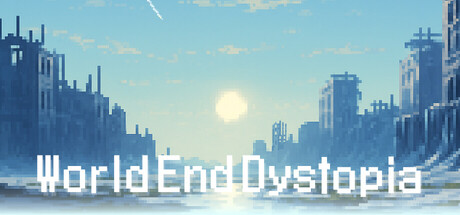
In World End Dystopia, AI technology is used as a supplementary tool in certain parts of the production process. AI supports tasks such as prototyping, comparison, and organization, while the worldbuilding, narrative, game design, and all final expressions and decisions are created entirely by human hands.
Just as the AI “EDEN” depicted in the game exists to support human choice, AI in the real-world development process is likewise limited to an assistive role—supporting human understanding and judgment rather than replacing creativity or decision-making.
The current version of the game utilizes a variety of AI-assisted / AI-generated assets to support its development. My intent is to eventually replace or further polish as many of these assets as is feasible during the Early Access journey, though this remains a long-term aspiration.
- 2D Assets: Some character portraits, backgrounds, minor textures, and store artwork are generated or enhanced using AI (e.g. style transfer from custom 3D renders and upscaling). These assets are further edited and integrated manually.
- Narrative Slides: Images used in story sequences are AI-generated and used with minimal or no manual modification.
- Voice Acting: Dialogue voiceovers use text-to-speech (TTS).
- Text: Store descriptions, in-game text, and dialogue are written by the developer and refined using AI tools for clarity, consistency, and phrasing (e.g. tooltips and ability descriptions).
Generative AI was used during development to assist in the creation of:
Assets: Textures, Sound Effects, Music, and Voice.
Development: Code and Narrative Text.
All AI-generated content has been manually refined and integrated by our team to ensure high quality and originality. Many of these tools were utilized primarily for concepting and prototyping to streamline our production workflow.
This game is adapted from an original short story written and owned by the developer. The story and all narrative content are original creative works with no AI-generated writing. The English script was produced with Claude's assistance to adapt the setting and dialogue style to small-town Ohio. Visual assets were generated using Seedance 2.0. Game code is built on Nova, an open-source visual novel framework, and is not AI-generated.
We use AI in early conceptual design, to figure out an appropriate background art. We then go through several iterations manually with artist modifications, to produce a good, highly polished background that gels well with our characters, story and intended art style.
Our characters are hand drawn by humans.
Our objects are hand drawn by humans.
All user interface (UI) elements are hand drawn by humans.
All animations are hand drawn and meticulously rigged (also by humans) using bone animation.
This is a visual novel independently developed by an individual with no budget. It is based on an existing novel, with parts of the narrative text synthesized and refined using AI, which has been repeatedly checked, edited, and approved by the developer. The game's scenes and character models are also AI-generated, and have undergone extensive debugging, deletion, revision, and final confirmation before release to ensure compliance and quality.
Generative AI tools were used during development to assist in the creation of certain game assets, including 3D models, textures, images, voice processing, character dialogue, music, and sound effects. All AI-assisted content was reviewed, edited, and integrated by the developer to ensure quality and consistency with the game’s artistic vision.
Inside Wave understands the concerns surrounding generative AI. Since the Inside Wave is currently a solo developer, AI is applied in areas that are impossible or extremely difficult to implement effectively without additional resources and specialists.
The promotional assets used in the store for this free game (cover image and the screen animation in the trailer) were created with the help of artificial intelligence.
AI-generated tools were used to assist in the creation of certain promotional artwork displayed on the Steam store page. No AI-generated content is used within the gameplay, story, audio, or interactive elements of the game.
Since our team is very small, due to a lack of certain skills and time, for now we had to use AI to create some of the icons and music in our game, as placeholders that will be replaced by handcrafted art in the future. All other visual content was created by real people.
Players can freely converse with NPCs, and the game will generate dialogue in real time based on the NPCs' personalities and memories.
The main storyline will be driven by AI agents, which will generate plotlines consistent with the game's lore.
Most of the images in the game, as well as marketing materials, have been generated through AI or have had AI filters applied to them for the sake of a consistent art style. Some of the game's text has also been AI-generated, though to a much lesser extent.
All of it has been manually reviewed and has had corrections applied where needed.
Images in-game and marketing were designed by us, then generated with ChatGPT, then modified and edited by us. Coding support from ChatGPT Codex, that has been so much help.
Just used to help make the game.
AI was used in the coding of this game. Some placeholder assets are AI, but rest assured we have excellent human artists working hard to replace every asset with hand-made human art by release!
Artificial intelligence was used during the pre-production phase to assist in concept design, reference generation, and the creation of a few 3D models and textures.
No AI-generated content is created or modified during gameplay, and players do not directly interact with any AI systems within the game.
This game uses Chat GPT 4o, Gemini 2.0, and Stable Diffusion (Model: AnythingXL) for background drawing, cover backgrounds, some props for compositing, and a small number of character illustrations.
Very limited use of AI generated content:
The city skyline image, and dialogue from text-to-speech are the only items/content where an AI tool was used. *The relevant AI platforms' subscription tier clarified full ownership of content and uniqueness of rendered content. Also, allowance of both commercial and non-commercial legal use is permissible with regard to both platforms used.
I use AI to design my Steam page. The cover was made half with the help of AI. The text was prepared in advance to fit the page layout. The logo was also created using this tool.
This game makes limited use of generative Artificial Intelligence strictly to support the creation of certain pre-rendered assets, such as visual concepts, object drafts, and artistic reference material. All AI-assisted content was subsequently edited, refined, and manually integrated by the development team.
AI is not used to generate content dynamically during gameplay, nor does it create dialogues, decisions, code, or any element that affects the player's real-time experience. The final game—its story, mechanics, core art, lighting, audio, and all interactive systems—was created manually.
AI was used only as a creative support tool during development, fully respecting copyright, ethical guidelines, and Steam policies.
The promotional video visuals, character portrait concepts, and trailer voiceovers for this game were assisted by generative AI tools (such as Midjourney and ElevenLabs). All AI-generated assets have been strictly curated, manually edited, and composited by the developer to ensure they match the game's creative vision.
Artificial intelligence (AI) was leveraged for key aspects of the game's development, including in-game logic, support systems, and certain artistic assets.
This app includes pre-generated content created or assisted using generative AI.
This includes the game logo, title screen, certain story-related images used during key moments of the game, a majority of item-related visuals (such as weapons, armors, accessories, and quest items), and approximately 60% of character portraits used in dialogue.
All such content was selected, reviewed, and in many cases manually edited and integrated by the developer before being included in the game or on the store page.
Additionally, most of the game's plugins were developed with the assistance of AI tools. No AI is used at runtime or during gameplay.
As a solo developer working on a passion project, I utilized generative AI tools to assist in creating some of the visual assets for the game. This includes character portraits, background art, and certain UI elements. All music, audio and localization in the game are entirely human-made and do not use any generative AI technologies.
The in-game graphics and sound are generated by AI and then modified and adjusted by creators before being used.
In World End Dystopia, AI technology is used as a supplementary tool in certain parts of the production process. AI supports tasks such as prototyping, comparison, and organization, while the worldbuilding, narrative, game design, and all final expressions and decisions are created entirely by human hands.
Just as the AI “EDEN” depicted in the game exists to support human choice, AI in the real-world development process is likewise limited to an assistive role—supporting human understanding and judgment rather than replacing creativity or decision-making.
The current version of the game utilizes a variety of AI-assisted / AI-generated assets to support its development. My intent is to eventually replace or further polish as many of these assets as is feasible during the Early Access journey, though this remains a long-term aspiration.
- 2D Assets: Some character portraits, backgrounds, minor textures, and store artwork are generated or enhanced using AI (e.g. style transfer from custom 3D renders and upscaling). These assets are further edited and integrated manually.
- Narrative Slides: Images used in story sequences are AI-generated and used with minimal or no manual modification.
- Voice Acting: Dialogue voiceovers use text-to-speech (TTS).
- Text: Store descriptions, in-game text, and dialogue are written by the developer and refined using AI tools for clarity, consistency, and phrasing (e.g. tooltips and ability descriptions).
Generative AI was used during development to assist in the creation of:
Assets: Textures, Sound Effects, Music, and Voice.
Development: Code and Narrative Text.
All AI-generated content has been manually refined and integrated by our team to ensure high quality and originality. Many of these tools were utilized primarily for concepting and prototyping to streamline our production workflow.
This game is adapted from an original short story written and owned by the developer. The story and all narrative content are original creative works with no AI-generated writing. The English script was produced with Claude's assistance to adapt the setting and dialogue style to small-town Ohio. Visual assets were generated using Seedance 2.0. Game code is built on Nova, an open-source visual novel framework, and is not AI-generated.
We use AI in early conceptual design, to figure out an appropriate background art. We then go through several iterations manually with artist modifications, to produce a good, highly polished background that gels well with our characters, story and intended art style.
Our characters are hand drawn by humans.
Our objects are hand drawn by humans.
All user interface (UI) elements are hand drawn by humans.
All animations are hand drawn and meticulously rigged (also by humans) using bone animation.
This is a visual novel independently developed by an individual with no budget. It is based on an existing novel, with parts of the narrative text synthesized and refined using AI, which has been repeatedly checked, edited, and approved by the developer. The game's scenes and character models are also AI-generated, and have undergone extensive debugging, deletion, revision, and final confirmation before release to ensure compliance and quality.
Generative AI tools were used during development to assist in the creation of certain game assets, including 3D models, textures, images, voice processing, character dialogue, music, and sound effects. All AI-assisted content was reviewed, edited, and integrated by the developer to ensure quality and consistency with the game’s artistic vision.
Inside Wave understands the concerns surrounding generative AI. Since the Inside Wave is currently a solo developer, AI is applied in areas that are impossible or extremely difficult to implement effectively without additional resources and specialists.
The promotional assets used in the store for this free game (cover image and the screen animation in the trailer) were created with the help of artificial intelligence.
AI-generated tools were used to assist in the creation of certain promotional artwork displayed on the Steam store page. No AI-generated content is used within the gameplay, story, audio, or interactive elements of the game.
Since our team is very small, due to a lack of certain skills and time, for now we had to use AI to create some of the icons and music in our game, as placeholders that will be replaced by handcrafted art in the future. All other visual content was created by real people.
Players can freely converse with NPCs, and the game will generate dialogue in real time based on the NPCs' personalities and memories.
The main storyline will be driven by AI agents, which will generate plotlines consistent with the game's lore.
Most of the images in the game, as well as marketing materials, have been generated through AI or have had AI filters applied to them for the sake of a consistent art style. Some of the game's text has also been AI-generated, though to a much lesser extent.
All of it has been manually reviewed and has had corrections applied where needed.
Images in-game and marketing were designed by us, then generated with ChatGPT, then modified and edited by us. Coding support from ChatGPT Codex, that has been so much help.
Just used to help make the game.
AI was used in the coding of this game. Some placeholder assets are AI, but rest assured we have excellent human artists working hard to replace every asset with hand-made human art by release!
Artificial intelligence was used during the pre-production phase to assist in concept design, reference generation, and the creation of a few 3D models and textures.
No AI-generated content is created or modified during gameplay, and players do not directly interact with any AI systems within the game.
This game uses Chat GPT 4o, Gemini 2.0, and Stable Diffusion (Model: AnythingXL) for background drawing, cover backgrounds, some props for compositing, and a small number of character illustrations.
Very limited use of AI generated content:
The city skyline image, and dialogue from text-to-speech are the only items/content where an AI tool was used. *The relevant AI platforms' subscription tier clarified full ownership of content and uniqueness of rendered content. Also, allowance of both commercial and non-commercial legal use is permissible with regard to both platforms used.
I use AI to design my Steam page. The cover was made half with the help of AI. The text was prepared in advance to fit the page layout. The logo was also created using this tool.
This game makes limited use of generative Artificial Intelligence strictly to support the creation of certain pre-rendered assets, such as visual concepts, object drafts, and artistic reference material. All AI-assisted content was subsequently edited, refined, and manually integrated by the development team.
AI is not used to generate content dynamically during gameplay, nor does it create dialogues, decisions, code, or any element that affects the player's real-time experience. The final game—its story, mechanics, core art, lighting, audio, and all interactive systems—was created manually.
AI was used only as a creative support tool during development, fully respecting copyright, ethical guidelines, and Steam policies.