Public Steam disclosure research25,376 disclosures tracked
Where do games disclose AI use?
Search developers’ Steam disclosures, compare classified AI use across
games, and follow recorded changes.
This index adds cross-game classifications and statistics to
statements published on individual store pages.
Groups reflect automatic analysis of public disclosures; mature records are excluded. These counts do not measure AI use across all of Steam.
Missing or unclear statements cannot establish whether a game uses AI.
The game uses real-time AI models to simulate immersive conversations with the non-player characters you meet in-game. Each character has a hand-written backstory that impacts how the conversation goes. This technology complements the manual worldbuilding and lore writing, and I would love your feedback on how well you think this works!
AI, employed for the purpose of narrative refinement, intricately weaves the storyline into a captivating tapestry while preserving the fundamental essence envisioned by the developer. It is imperative to acknowledge that every narrative and enigma originates from the creative prowess of the developer, whose ingenuity shapes tales grounded in actuality.Only the steam page art are generated with AI.
Starting with the version 1.3 patch, AI tools were used to make minor translation updates to French, Spanish and German text in conjunction with a review by a professional.
Generative AI is used for translations into languages I do not master and to create early 3D model prototypes. These prototypes are manually refined before being integrated into the game. No generative AI is used during gameplay or to dynamically generate in-game content.
We used generative AI for: art on the store page, and some in-game textures. Each AI-generated content was then manually adjusted by our in-house artist to ensure the presence of human input in the art and high quality of the game.
GenAI is used to create 2D character design concepts as reference images for 3D modeling.
It is also used for some UI icons, a limited number of 3D asset models, and translation of in-game character dialogue.
During development we use AI assistance in certain tasks, such as upscaling in-game assets to higher detail versions. An example would be creating higher detail 2D UI portraits for NPCs in their in-game environment from the in-game art. All original artwork and the final creative vision come from our development team.
The game has optional computer generated voice overs.
Out of a total of 12 music tracks, 9 were produced using AI. A total of 25 villager profile pictures were generated with AI. All languages except German, French, Polish, Brazilian Portuguese, and Turkish were translated using AI.
AI was used in the creation of the Steam capsule logo.
Some translations, voicelines, and assets were made using generative AI. All carefully inspected by the developer.
This is used to speed up the development, and is being slowly replaced with artists authored assets.
No generative AI is used during gameplay.
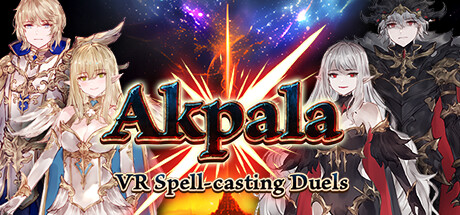
In this game Akpala, there is a feature that allows players to converse with NPC characters during gameplay.
For the responses to the player's voice input, we use AI-generated text.
Certain graphic elements and textures in this game were created through a combination of licensed generative AI and traditional composition, including some patterns for materials, certain user interface icons, and some character faces.
Our game's library images (except for the logo with the words "Investormania"), images on the in-game loading screen, in-game avatars are generated with artificial intelligence.
As a solo developer, I use AI to brainstorm drafts for some of the 2D assets, which I then edit by hand. These will be replaced with hand-drawn assets by release.
AI generated concept art may end up in the game in some derivative form. AI may be used to debug, improve, or prototype code. This applies only to a small subset of content. The majority of content in the game does not involve AI generated content.
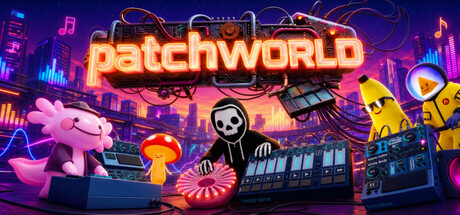
PatchWorld includes optional generative AI tools that players can use to create custom content for their worlds and devices.
Players can generate images, 360° skyboxes, 3D meshes, and audio samples by entering text prompts using in-game tools such as the GenieBox device or scripting blocks. Each generation is initiated directly by the player and takes a short amount of time to complete.
Generated content can be used to decorate worlds, create sound effects, and build custom musical instruments. By default, all generated content remains private to the creator and is only shared with others if the player chooses to publish their world.
Generative AI features are entirely optional and are designed to support creativity, experimentation, and collaborative world-building.
During the development process, we may use procedural- and AI-based tools to assist with content creation. This includes generating reference- and base-material for 2D art as well as text-to-speech audio material.
AI-generated story invention
AI generated audios
AI-generated translation
AI generated videos
AI generated images
This game use AI Art. Special Thanks to the following Creators of...
KLING AI (Videos)
Wonder AI (2D Graphics)
Runway AI (Trailer Voice)
Chat-GPT / OpenAI (Translation)
DALL-E (2D Graphics)
Replica AI (Voice)
Meshy.ai (3D Models)
Creator
Playbosh Games Entertainment UG (haftungsbeschränkt)
We do not use generative AI for models, textures, animations, audio, etc. All visuals are handmade with love!
To allow quickly updating the game during Early Access, we use a combination of machine translation, human review, and entirely human authored localization. The current state of languages is: Chinese, Japanese, Korean, and Russian are mostly human authored; French and Spanish are machine translated with human authored revisions; German is machine translated. Our goal is to increase the amount of human authored localization over time.
Players can create and modify games using text prompts. The game uses AI (LLM) to understand the player's request and then uses LLM to construct the game using a pre-defined asset library.
This game uses artificial intelligence (AI) tools to help optimize code and improve development efficiency and runtime performance. Additionally, character voices in the game were recorded by the developer himself. The voice was then synthesised by AI to create different character voices. These technologies enhance the overall quality and experience of the game.
The game uses real-time AI models to simulate immersive conversations with the non-player characters you meet in-game. Each character has a hand-written backstory that impacts how the conversation goes. This technology complements the manual worldbuilding and lore writing, and I would love your feedback on how well you think this works!
AI, employed for the purpose of narrative refinement, intricately weaves the storyline into a captivating tapestry while preserving the fundamental essence envisioned by the developer. It is imperative to acknowledge that every narrative and enigma originates from the creative prowess of the developer, whose ingenuity shapes tales grounded in actuality.Only the steam page art are generated with AI.
Starting with the version 1.3 patch, AI tools were used to make minor translation updates to French, Spanish and German text in conjunction with a review by a professional.
Generative AI is used for translations into languages I do not master and to create early 3D model prototypes. These prototypes are manually refined before being integrated into the game. No generative AI is used during gameplay or to dynamically generate in-game content.
We used generative AI for: art on the store page, and some in-game textures. Each AI-generated content was then manually adjusted by our in-house artist to ensure the presence of human input in the art and high quality of the game.
GenAI is used to create 2D character design concepts as reference images for 3D modeling.
It is also used for some UI icons, a limited number of 3D asset models, and translation of in-game character dialogue.
During development we use AI assistance in certain tasks, such as upscaling in-game assets to higher detail versions. An example would be creating higher detail 2D UI portraits for NPCs in their in-game environment from the in-game art. All original artwork and the final creative vision come from our development team.
The game has optional computer generated voice overs.
Out of a total of 12 music tracks, 9 were produced using AI. A total of 25 villager profile pictures were generated with AI. All languages except German, French, Polish, Brazilian Portuguese, and Turkish were translated using AI.
AI was used in the creation of the Steam capsule logo.
Some translations, voicelines, and assets were made using generative AI. All carefully inspected by the developer.
This is used to speed up the development, and is being slowly replaced with artists authored assets.
No generative AI is used during gameplay.
In this game Akpala, there is a feature that allows players to converse with NPC characters during gameplay.
For the responses to the player's voice input, we use AI-generated text.
Certain graphic elements and textures in this game were created through a combination of licensed generative AI and traditional composition, including some patterns for materials, certain user interface icons, and some character faces.
Our game's library images (except for the logo with the words "Investormania"), images on the in-game loading screen, in-game avatars are generated with artificial intelligence.
As a solo developer, I use AI to brainstorm drafts for some of the 2D assets, which I then edit by hand. These will be replaced with hand-drawn assets by release.
AI generated concept art may end up in the game in some derivative form. AI may be used to debug, improve, or prototype code. This applies only to a small subset of content. The majority of content in the game does not involve AI generated content.
PatchWorld includes optional generative AI tools that players can use to create custom content for their worlds and devices.
Players can generate images, 360° skyboxes, 3D meshes, and audio samples by entering text prompts using in-game tools such as the GenieBox device or scripting blocks. Each generation is initiated directly by the player and takes a short amount of time to complete.
Generated content can be used to decorate worlds, create sound effects, and build custom musical instruments. By default, all generated content remains private to the creator and is only shared with others if the player chooses to publish their world.
Generative AI features are entirely optional and are designed to support creativity, experimentation, and collaborative world-building.
During the development process, we may use procedural- and AI-based tools to assist with content creation. This includes generating reference- and base-material for 2D art as well as text-to-speech audio material.
AI-generated story invention
AI generated audios
AI-generated translation
AI generated videos
AI generated images
This game use AI Art. Special Thanks to the following Creators of...
KLING AI (Videos)
Wonder AI (2D Graphics)
Runway AI (Trailer Voice)
Chat-GPT / OpenAI (Translation)
DALL-E (2D Graphics)
Replica AI (Voice)
Meshy.ai (3D Models)
Playbosh Games Entertainment UG (haftungsbeschränkt)
We do not use generative AI for models, textures, animations, audio, etc. All visuals are handmade with love!
To allow quickly updating the game during Early Access, we use a combination of machine translation, human review, and entirely human authored localization. The current state of languages is: Chinese, Japanese, Korean, and Russian are mostly human authored; French and Spanish are machine translated with human authored revisions; German is machine translated. Our goal is to increase the amount of human authored localization over time.
Players can create and modify games using text prompts. The game uses AI (LLM) to understand the player's request and then uses LLM to construct the game using a pre-defined asset library.
This game uses artificial intelligence (AI) tools to help optimize code and improve development efficiency and runtime performance. Additionally, character voices in the game were recorded by the developer himself. The voice was then synthesised by AI to create different character voices. These technologies enhance the overall quality and experience of the game.