Public Steam disclosure research27,951 disclosures tracked
Where do games disclose AI use?
Search developers’ Steam disclosures, compare classified AI use across
games, and follow recorded changes.
This index adds cross-game classifications and statistics to
statements published on individual store pages.
Groups reflect automatic analysis of public disclosures; mature records are excluded. These counts do not measure AI use across all of Steam.
Missing or unclear statements cannot establish whether a game uses AI.
During the development of this game, generative AI technologies were utilized to assist in creating certain 3D models and character/environmental textures. All AI-assisted assets have been manually refined, optimized, and reviewed to ensure high quality and full compliance with platform copyright policies.
AI was used to assist with the localization process.
All other core game content including game design, programming, art direction, and gameplay systems
was created by the human development team.
Some visual assets, concept art, character portraits, promotional images, and store-related materials may be created or assisted using generative AI tools. All AI-assisted content is reviewed and edited by the developer before use. The game does not use real-time AI generation during gameplay.
Some temporary horror sound effects and vocal effects in this game were created using generative AI tools during development. These assets have been reviewed and integrated by the developer. As development continues and resources become available, these temporary AI-generated audio assets may be replaced with recordings created by professional voice actors and sound engineers to further enhance the game's atmosphere and realism.
ERLIK is a solo project. The game design, mechanics, balance, folklore research and English writing are my own work. Nothing is generated while you play. The translations were AI-assisted and then reviewed. Generative AI tools were used for parts of the art and sound; every asset was directed, edited and tuned by hand to fit the game.
The videos were generated using artificial intelligence, employed to recreate the gothic and unsettling atmospheres typical of 1970s and 1980s horror films.
Human-crafted with AI assistance. Generative AI was used to assist with selected programming tasks (such as code optimization and debugging), create or enhance some voice-over and audio elements, and help refine selected graphical assets and some photos. All AI-generated content was reviewed, edited, integrated, and finalized by the developer.
The background music was created with Suno and the intro narration with ElevenLabs. This content was generated during development, reviewed by the developer, and baked into the build. All sound effects are synthesized in code at runtime and all art is generated procedurally in code — neither is AI.
Gemini was used to assist in creating card art and art in backgrounds based off of a Fantasy setting from a not yet published book which is copyrighted. Sounds were created using elevenlabs for card sounds and effects including vo.
The characters, monsters, images, and logos were generated using AI.
The 3D models of characters and monsters are generated and created by V2Fun, and the materials are licensed for commercial use based on the CC BY 4.0 protocol.
MegaDope 2D uses generative AI assisted tools during development to help create and refine visual assets, character and environment concepts, UI elements, music, sound effects, and promotional/trailer materials. All AI assisted assets are curated, edited, and implemented by the developer as part of the final game. The game does not currently generate new AI content live during gameplay.
Some promotional artwork and achievement icons were created using generative AI and then manually edited by the developer. No gameplay content is generated by AI.
Approximately 90% of Haunted House's content (art, text, narrative, game design, and code) is AI-generated, using ComfyUI / Stable Diffusion with custom LoRA, LLMs, and AI coding assistants. All AI outputs are reviewed, edited, and integrated by Hoppy, the sole developer. Music and sound effects are licensed, not AI-generated. No voice acting. Final creative direction and decisions are by Hoppy.
Our development process makes use of generative AI tools for internal tasks such as early concept exploration - both for the game and marketing assets, as well as workflow automation. All final game assets are created by our team without AI-generated content.
"We used generative AI tools during the development of this game. Specifically, pre-generated AI tools were utilized to create and refine some of the 2D visual assets, including concept art, UI elements, and promotional store graphics. All AI-generated content was reviewed, edited, and curated by our team to ensure quality and compliance with Steam's content policies. The game itself does not generate any live AI content during runtime."
Some store page promotional artworks and trailer footage materials are assisted and initially generated by AI tools. All AI-generated content has been deeply manually revised, adjusted and optimized by our development team to ensure originality and compliance. No runtime AI dynamic content will be generated during the game running process.
This game contains pre-generated AI content. Certain in-game dialogue voice lines were created using AI-generated voices. No live AI generation occurs during gameplay, and no user-generated AI content is included.
Generative AI tools were used during development to assist with code review, debugging and code refinement, as well as to translate texts, create and enhance certain digital artwork and visual assets included in the game.
Azura uses artificial intelligence to accelerate card prototyping, character ideas, and mechanic balancing, always providing creative support. All final content goes through human curation and collaborations with artists, ensuring a visually unique and soulful game.
The Event currently includes three AI-generated projector scenes used only as temporary placeholders, pending replacement with human-made artwork in the near future.(feel free to contact me for any possible collaborations)
Aside from these placeholder scenes, the remaining voice work, including the double voice effects, was created directly by the developer.
This game includes AI-assisted source assets for selected textures, environmental artwork, and portions of the soundtrack. All such materials were reviewed, substantially modified where needed, and manually integrated to fit the game's artistic direction. AI coding assistants were also used during development to improve productivity. Game design, programming, gameplay, balancing, and final creative decisions were performed by the developer.
Some 2D art assets in this game such as certain UI elements, background and map imagery, and loading screens were created with the help of generative AI tools.
Built solo with Cursor AI, Realmlords is a one-developer passion project: an action roguelite forged through rapid iteration, creative experimentation, and nonstop refinement from a single creator’s vision. Over 2 years in the making.
This title makes assistive use of generative AI tools in the following areas. All AI-generated outputs are manually reviewed, edited, and curated by the development team before being incorporated as final assets, and we have taken care to ensure that they do not infringe on the rights of third parties. No real-time AI generation occurs during gameplay.[Pre-Rendered Content — AI-Assisted Areas]- Production support for a portion of the in-game visual assets- Production support for a portion of the in-game music (BGM) and sound effects- Translation support for store page localization across supported languages (with human proofreading)[Live Generation]The game does not invoke generative AI in real time at any point during gameplay.
AI was used during development to help fix scripting errors and improve development efficiency. No AI was used in the creation of the game’s levels, menus, UI, or graphic designs.
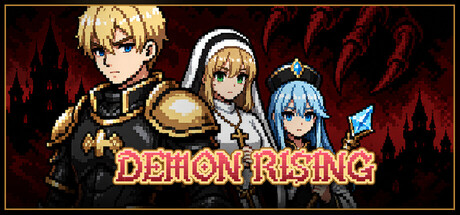
Demon Rising uses generative AI for part of its content:
Live-generated narrative — The game includes a local AI language model that runs fully offline on your PC; no internet connection is required and no data is sent anywhere. During play it generates dynamic dialogue for your demon officers, war-council debates, prisoner interrogations and boss encounters, keeping conversations varied across runs. All generated text is constrained by the game's prompts to in-game characters and situations and is bounded by built-in safeguards. If the AI model is unavailable, the game automatically falls back to hand-written dialogue, so the full game is playable either way.
Pre-generated artwork — Some character portraits and illustrations were created with the help of AI image-generation tools, then selected and edited by the developer.
All AI-assisted content is curated and reviewed by the developer.