Public Steam disclosure research27,951 disclosures tracked
Where do games disclose AI use?
Search developers’ Steam disclosures, compare classified AI use across
games, and follow recorded changes.
This index adds cross-game classifications and statistics to
statements published on individual store pages.
Groups reflect automatic analysis of public disclosures; mature records are excluded. These counts do not measure AI use across all of Steam.
Missing or unclear statements cannot establish whether a game uses AI.
AeroStudio 3D itself contains no AI and generates nothing while it runs. The program code, the interface text, its translations and this store page were made with AI assistance and checked by the developer. The store and library artwork, including the logo, was generated with AI.
Fabricator itself contains no AI and generates nothing while it runs. The program code, the interface text, its translations and this store page were made with AI assistance and checked by the developer. The store and library artwork, including the logo, was generated with AI.
Mass3D itself contains no AI and generates nothing while it runs. The program code, the interface text, its translations and this store page were made with AI assistance and checked by the developer. The store and library artwork, including the logo, was generated with AI. The models shown in the trailer and screenshots were built inside Mass3D by scripts written with AI assistance, and the trailer music was made by a program written with AI assistance.
Gain3D itself contains no AI and generates nothing while it runs. The program code, the interface text, its translations and this store page were made with AI assistance and checked by the developer. The store and library artwork, including the logo, was generated with AI.
ProtoForge itself contains no AI and generates nothing while it runs. The program code, the interface text, its translations and this store page were made with AI assistance and checked by the developer. The store and library backdrops were generated with AI. The logo was modelled in ProtoForge itself.
I program MaterialEX with the help of Claude, by Anthropic: it helps me write and review the code, the text on this page and the English translation of the interface. The design and the decisions are mine, and every change passes more than 2,600 automated tests. MaterialEX does not generate any content with AI: textures and materials come from the program's own tools or from your work, and it doesn't connect to any AI service.
Some of the game's sound effects (about 80 interface, race and medal sounds) were generated with an AI tool (Higgsfield Seed Audio), then selected, edited and mixed by the developer. No content is generated by AI during gameplay.
This tool uses different AI models to generate images, as well as 3D and 2D models.
Name of AI model included with the game: TripoSR, MIA, SkinTokens, Z image Turbo
Portions of the application's source code were written with AI assistance under
the direction, review and testing of the developer. The application itself
contains no generative AI: all simulation output is deterministic physics driven
entirely by the user's input. No AI-generated art, audio or text assets are
shipped in the product.
We used AI tools during development to help create the game's characters, companions, buildings and props, and a few textures. Every asset was reviewed and finished by hand before release. The landscapes, water and lighting were built by hand in Blender, and the trees, plants, rocks and skies come from Poly Haven. Some shots in our trailers are AI-generated video with synthetic voices.
World itself generates nothing and sends nothing to any AI service. If you run AI coding agents under your own accounts, their code and text show up in their own terminals, as you'd see it anywhere else; World only displays them.
Connects to 3rd-Party Service for AI Content Generation: None built in. Players may run their own Claude Code (Anthropic), Codex CLI (OpenAI), Antigravity CLI (Google), Grok Build (xAI) or Docker Agent through Agent Guild.
Generative AI tools were used during development to assist with coding and content creation. All AI-generated content was reviewed and edited by our development team. No generative AI is used during gameplay.
PoseSIMPLY uses AI models that run locally on your PC (Meta SAM 3D Body for body and hand pose, Depth Anything V2 for depth) to estimate a 3D pose from the photo, video or webcam image you provide. They only measure the pose of the person in your input; they do not create images, text, voices or artwork. All bundled art, models and sample content were made without generative AI. No external AI service is used.
[AI use during development]AI coding assistants were used in writing this software's code. The bundled sample character and sample sword 3D models were made with an AI 3D generation service.[AI use inside the software]- Auto-rigging: an AI model running locally on the user's PC (nothing is sent externally).- Background removal: an AI model running locally on the user's PC (nothing is sent externally).- Manual rigging, motion application, and sprite rendering: standard 3D processing. No AI is used.The software does not send data to any external AI service. Only when the user turns on MCP (control from an AI app) are results passed to the user's own AI app (off by default).
We used generative AI tools during development to help create part of the concept arts, icons, sounds, 2D and 3D assets. Some outputs served as temporary placeholders; others were used in our asset production pipeline where our team revised, edited or reworked the assets to align with our creative direction.
FLECK includes an optional, fully local AI sprite generator. At the user's request it can generate small pixel-art images from a text prompt using an on-device image model (weights are downloaded on first use and run entirely on the user's machine; no online AI service is used). Generated images only appear in the user's own documents. All built-in artwork, the store page and marketing materials were made by hand without generative AI.
VTuberPro Workstation uses locally running AI models to separate user-provided character illustrations into avatar parts, reconstruct hidden areas, and estimate depth. The AI processing runs on the user's PC rather than an external AI service. Some pre-generated artwork, including the app icon and built-in accessories, and interface translations were created with AI assistance. Automatic results vary with the input artwork and may require manual editing.
Claude Code was used in the development of Comicalizer for the purposes listed below. The only generative AI used to create the text, data or images included in the software was Claude Code, along with Codex and Gemini as supplementary coding assistants.
■ Text
The translations of the interface text into each language, the sample plots, and parts of the help text and store page text are based on drafts written by Claude Code. The Japanese text and all final content were decided by the developer.
■ Program code
Claude Code was used as a coding assistant during implementation, bug fixing and testing. Almost all of the code was written with Claude Code; Codex and Gemini were also used to help with a small part of it.
■ Research
Part of the research behind the features (reference material for the staging dictionary, the style presets, the background sets and so on) was done with a chat-based generative AI. The text and values in the software were written from that research with Claude Code, and the developer decided the final content.
■ Made without AI
The bundled 3D characters are models the developer created in VRoid Studio. The balloon lettering is based on the "GenEi Antique" font (SIL Open Font License 1.1).
The character on the store capsules and library images is an illustration hand-drawn by the developer (the manuscript page in the illustration was drawn by this software). The screenshots and the trailer are made from screens actually drawn by this software, combined with fonts and simple shapes. No AI that generates images or music was used.
■ How it works
Panel layouts, camera angles, poses and so on are assembled using random numbers, predefined rules and score calculations. The software never uses generative AI to create images or text while it runs, and it connects to the internet only when you send a message from “✉ Contact”, sending only what you wrote.
■ Developer responsibility
The developer takes responsibility for all included content and checks it for anything inappropriate or anything that may infringe on the rights of others.
Generative AI was used to assist with portions of the artwork and promotional banners for Fireworks Premier, including certain Steam store and library graphics. Fireworks simulations and animations are rendered procedurally by the application. Fireworks Premier does not generate AI content during use or connect to external AI services.
This software includes an optional AI assistant that can draw on the canvas from
a text description.
It is "bring your own key" (BYOK): the AI features work only with your own
account at a third-party AI provider that you choose and pay for yourself
(OpenAI, DeepSeek, Moonshot, Zhipu, Qwen, OpenRouter, or a local model running
on your own machine via Ollama / LM Studio). We do not host, resell or proxy any
AI service, we do not sell AI usage, and we take no cut of it. The editor itself
works fully offline with no AI connection at all.
AI output is applied to your canvas as ordinary, undoable edits - you can undo,
paint over or delete anything the AI produces.
Guardrails: every AI request passes through a built-in, offline content filter
before it is sent to the provider. It blocks requests for (1) sexual content
involving minors, (2) explicit sexual content, (3) instructions for illegal
manufacture, and (4) hate or extremist propaganda. Filtered requests are never
sent. Anything not blocked remains subject to your provider's own usage policies.
Pre-generated AI content: the application icon and store artwork were created
with AI tools and then edited by hand; parts of the source code were written with
the help of AI coding assistants.
Generative AI was used during development as a programming assistance tool and to help create selected pre-generated visual assets and marketing materials. All such content is reviewed and curated by the developer. Battle Animator does not generate AI content during runtime and does not connect to external AI services.
Pixora was developed with AI-assisted tools, which were used to support certain aspects of coding and the creation of promotional materials for the store page. All AI-generated content used in the project is permitted for commercial use under the applicable licenses.
Some included character, animal, creature and sample images were created with generative AI and then edited and prepared for the product. Generative AI also assisted with localization. MEMEMINT does not generate new images or text with generative AI during use and does not connect to a third-party generative AI service. Its local background-removal feature uses a non-generative segmentation model.
During the development process, our team may utilize AI-based tools in a limited, supplementary capacity to support content creation. This includes the creation of certain 2D prop assets and soundtrack pieces, as well as the localization of some languages. In all cases, the final touches and quality review were carried out by our own team, and the final product reflects our team's creativity and artistic expression.
AIpark offers optional local AI image and short-video creation, with a bundled starter image model and downloadable video models. Generation is user-initiated and runs locally. Sexually explicit content generation is prohibited.
Name of AI model included with the game: Tiny-SD (local text-to-image); Wan 2.2 TI2V-5B INT8 via WanGP 18.05 (local text-to-video); Content Safety Guard Small (local prompt moderation).
Generative AI was used to assist in the creation of some in-game images, textures, dialogue, store page text, and localization. All AI-assisted content was reviewed, edited, and implemented by the developer. No live-generated AI content is used during gameplay.
StreamLay does not include AI-generated art, audio, or video assets.
Users provide character sprites or create them independently.
AI assistance was used during development to
help write code and draft store page text and documentation only.
Some of Voxitect's promotional artwork was created with the assistance of generative AI image tools. The game itself contains no generative AI: it generates nothing at runtime, sends nothing to any AI service, and requires no AI account or API key.
This application's store page artwork (capsule images, banners) and the app icon were created using generative AI image tools, with the developer reviewing and curating the final assets. The application itself does not contain or generate any AI-generated visual content during runtime.
Desktop Companion uses generative AI: your companion's replies are generated live by a large language model that runs entirely on your own PC. The app ships with its own safety-tuned model; nothing is sent to an external AI service. Built-in, application-level safeguards screen generated content to block prohibited output.
Lyrica uses AI in the following areas:
- Translation of in-app text and store page descriptions from Japanese into other languages
- Proofreading of in-app text (e.g., making terminology and spelling consistent)
Product design and specification, UI/UX design, effect design, all artwork including the character illustrations, the bundled demo music, and the original Japanese text are created by humans. I do not train AI models, nor do I fine-tune existing ones, and I do not use material owned by others without permission.
The application itself contains no AI model and does not generate anything while running. Data you import into Lyrica is never used to train AI. Unless the material you bring in is itself AI-generated, nothing in the work you export from Lyrica is AI-generated.
Parts of this product were made with generative AI and checked by a person before release:
• The images and animated video loops in our wallpapers (bundled and official Workshop items), the desktop pet characters and their animations, and the guide mascots were generated with AI image and video models.
• The HTML, CSS, JavaScript and shader code of the bundled wallpapers, the store page text and its translations were drafted with AI assistance.
The application itself does not use generative AI while it runs: it creates no content, and nothing you do in Wallpaper — hardware readings, settings, your own photos and videos — is sent to any AI model. We run no servers of our own.
This software incorporates a local AI model, which is used solely to provide an "intelligent semantic search" service. When you enter a text description, the AI analyzes the semantics in real time and searches your local image library to display the most relevant image results. All search results are sourced from your local image library; the AI does not generate or create any new image or video content. Users can choose whether to enable this feature.
An AI coding assistant was used while developing Orrery to write and review source code, and to draft the text of this store page. No artwork, audio, or in-app content is AI-generated: the planetary surface maps are re-projected NASA and USGS imagery from Solar System Scope, every position is computed from published JPL and Hipparcos data, and the store images are captured from the running program by a script. Nothing is generated by AI while the program runs.
During the development of the application, artificial intelligence was utilized to generate supporting utility code and translate user interface localization options into different languages.
Epoch Studio is a private writing and worldbuilding studio. When you ask it to, it can generate text suggestions and illustrations to help you develop your own manuscript. All generation runs locally on your own machine using bundled, permissively-licensed AI models — or optional cloud providers you connect with your own API key. Nothing is generated on its own: every suggestion is a deliberate action you take, and you review, edit, and decide what becomes part of your book. Your writing never leaves your device and is never used to train any AI model.
Automatic subtitles, object cutout and background removal use machine-learning
models (Whisper, BEN2, SAM 2) that run entirely on your PC to process your own
recordings and images. Nothing is uploaded and no cloud AI service is used in
this version. Every character and asset that ships with the application is
first-party 2D artwork; no pre-generated AI content is included.
Generative AI was used only as a writing aid: the first drafts of the character's short speech-bubble lines, the store page text and our support/privacy web pages were written with an LLM (Claude) and then reviewed and edited by our team. No AI-generated images, 3D models, animations, voices or music are used; the character model, motions and songs were created by people. Nothing is generated by AI at runtime.
3D models used in the game were pre-generated or generated with the assistance of AI technology prior to build deployment. All models have been reviewed, integrated, and verified to ensure they comply with rights, quality standards, and platform policies.
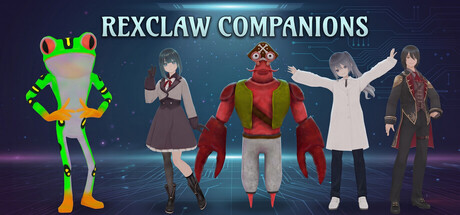
Rexclaw's companions are powered by generative AI, conversations (text and voice), along with files you create together are generated on demand by third party AI models. Some promotional artwork, including store banners, was created with AI assistance.
The English interface text in this application was translated from the Japanese original with AI translation tools then reviewed and corrected by the developer.
MoChat's free-form chat replies and some everyday messages are generated during play by AI. By default, a local language model runs on the player's PC, and chat content is not sent to external servers for AI generation.
Optionally, Windows players can connect their own API key from OpenAI, Anthropic (Claude), Google (Gemini) or xAI (Grok) in Settings instead. Only while this option is on, the player's chat messages, recent chat history, saved chat memories and the character's profile are sent directly from the player's PC to the selected provider to generate replies, under that provider's terms (for example, Google may use chats sent through Gemini's free tier to improve its products), and usage is billed to the player's own account. The key is encrypted by Windows and stored only on the player's PC. It is never sent to WhyDuck Studio. Players can delete the key or switch back to the local model at any time.
Characters are designed to follow developer-written personalities and content safety rules intended for all-ages conversations, whichever model is used. AI generates chat text only. Generative AI was also used to create some visual assets. These assets are not generated live during play.
Generative AI tools were used during development to create the game's visual art assets, including character images and animation/video assets. All AI-assisted content is pre-generated before release and included in the game. The game does not use generative AI to create content during gameplay.
Dashboard Engine uses AI only at runtime, on your own device, and bundles no pre-generated AI content.
On-device neural text-to-speech (installed by default): the app includes neural TTS voices (MeloTTS and Kokoro) that synthesize spoken audio from text locally on your PC. An English voice is bundled and installed by default; other languages download on demand. These voices produce speech at runtime — for the assistant's replies, spoken system alerts, and voice previews. They are used purely as speech output: a "voice profile" is a small set of tuning settings that reference a licensed base voice, and the app stores or uploads no voice recordings of any kind.
Optional AI assistant (off by default): if you turn it on, you connect it to a language model you run locally on your own machine or local network (for example Ollama or LM Studio). Your typed messages are sent to that local model to generate conversational replies in real time, which can be read aloud by the on-device TTS above. There is no cloud AI service, account, or API key — nothing leaves your PC.
All AI output is generated live from your own input and your own local models, so it is not authored or reviewed by the developer. No AI-generated content is pre-created or bundled with the app.
AI assistance was used to translate the user interface and this store page into non-English languages. The artwork, trailers, and original English text were created by the developer.
AI tools were used to assist in generating promotional artwork and store page graphics. Additionally, AI coding assistants were utilized during development to help write and optimize scripts and programming logic.