Public Steam disclosure research26,750 disclosures tracked
Where do games disclose AI use?
Search developers’ Steam disclosures, compare classified AI use across
games, and follow recorded changes.
This index adds cross-game classifications and statistics to
statements published on individual store pages.
Groups reflect automatic analysis of public disclosures; mature records are excluded. These counts do not measure AI use across all of Steam.
Missing or unclear statements cannot establish whether a game uses AI.
This game contains pre-rendered AI-generated content: some sound effects and store page artwork were created with generative AI tools, then reviewed and edited by the developer. No content is generated by AI in real time during gameplay.
Some store, interface, and world illustrations were created or refined with generative image tools, then selected and edited by the developer. Combat, economy, character progression, saves, and online play are written and run by the game server. The game does not use generative AI during play to write your progress, fight your battles, or replace other players.
This app includes an optional AI assistant that helps interpret game server console output and error logs. When you send it a log fragment or a question, the text goes to our backend, which forwards it to Anthropic's Claude API and returns a generated explanation with suggested fixes.
The assistant runs only when you invoke it — nothing is sent automatically, and the feature is off by default. Responses are generated by a language model and may be inaccurate, so verify any suggestion before applying it to a live server. No other content in this app is AI-generated.
Generative AI tools (such as Gemini) were used during development to assist in creating graphic design elements for in-game parody VHS cover art and store page graphic assets. All AI-generated artwork was manually curated, edited, and formatted into final 3D texture maps for the game's assets.
Generative AI tools, including Gemini and OpenAI tools, were used during development to create or edit some menu imagery, gameplay sprites and achievement artwork, and to assist with in-game text and localization. These assets and texts are included in the game as pre-generated content.
Parts of this game's text were created with the assistance of generative AI: the translation of the interface into several of its 13 supported languages, and portions of the store page text. All in-game art, music and sound effects are procedurally generated by hand-written code, not by AI, and no AI-generated content is created while you play.
Some content used in Skeleton Island was created with the assistance of generative AI tools during development. AI-generated or AI-assisted content may include visual assets, promotional materials, text, or other development materials.
Generative AI is not used to create new content during gameplay. The game does not generate AI content in real time based on player input.
Some of the text in this product was drafted with generative AI and then edited by the developer: parts of this store page description and some in-game text. Parts of the source code were also written with AI coding assistance and reviewed by hand.
The art, 3D models, animation and audio in this game are not AI-generated, and no generative AI runs while you play.
Generative AI tools were used during development to assist with selected visual assets and promotional materials. All AI-assisted content was reviewed and refined by the developer before use.
Generative AI was used during development to create some character, environment, and prop models, as well as music, sound effects, character voiceovers, and UI assets. These AI-generated assets were subsequently edited and refined by the development team before being integrated into the game.
Generative AI tools were used to assist with English localization and early drafts of in-game letter content. All AI-assisted text was reviewed and edited by the developer. No AI-generated images or audio are included.
Some pre-generated 2D artwork assets were created with the assistance of generative AI tools during development. These AI-assisted drafts were used as a starting point for cat sprites, adoption box artwork, icons, capsule images, trailer visuals, and some store screenshots. All final assets were selected, edited, adjusted, and reviewed by the developer before being included in the product. The game does not generate AI content during gameplay and does not connect to external AI services.
Generative AI tools were used to create some of the pre-rendered content that ships with this game and appears on this store page, specifically artwork and character voice audio. Nothing is generated by AI while the game is running.
Our team used AI tools to assist with improving some existing sketches and character elements, creating some background elements, and producing/ improving translations and character voices.
The vast majority of the game was created by our team without AI.
Generative AI tools were used during development to assist with the creation of a limited number of graphical assets and promotional materials. The selected content was reviewed, adapted, and integrated by the development team. The game does not use live-generated AI, and no content is generated while playing.
Generating base images and materials for certain environmental textures (such as doors and labels), which are then manually edited, dithered, and color-crushed to fit the game's low-poly PSX aesthetic.
Generating video clips, audio, and visual concepts for the television broadcasts (like the in-game cooking shows) that play on CRT monitors throughout the world.
We used generative AI tools during development in the following ways:
3D character models: The models for the supernatural guests (Nightmare, Goblin, Vampire, Devil), the merchant Djinn, and the trapped travelers were generated using AI tools (Meshy AI, with concept images from Google Gemini image models), then rigged, animated, retextured, lit, and integrated by hand in Unity.
Store artwork: The capsule key art was created with AI image generation tools and composed by hand.
Code: Portions of the game's source code were written with AI coding assistance and reviewed by the developer.
All AI-generated content was created by the developer using licensed tools, and all final assets were manually edited, integrated, and tested. No AI-generated content is produced live during gameplay — everything shipped in the game is pre-made and fixed.
This game uses AI-assisted tools during the development process to support the solo developer's workflow:
- 2D Art & Textures: Some background textures, UI elements, and concept art references were initially drafted using AI tools, followed by extensive manual repainting, editing, and refinement. All character designs, 3D models, are fully crafted and hand-painted by human artists. The story context is designed by myself.
- Audio: Certain background music tracks and ambient prototypes were generated with AI assistance. Character voice acting in story and core themes are produced by human creators.
No real-time (live-generated) AI is used during runtime.
Parts of the artwork were created with generative AI tools and then retouched by hand: several background illustrations, the title logo, and the store page capsule images.
Text outside Japanese — the in-game text in every other language and the store page translations — was produced with the help of AI.
Nothing is generated by AI while the game is running.
The game executable and in‑game assets contain no AI‑generated content. AI‑generated material is limited exclusively to the store page capsule artwork used on Steam.
Generative AI tools were used during the creation of some visual materials for the game. These materials were subsequently manually edited, refined, and adapted to match the project’s visual style. The game does not generate AI content during gameplay.
During our creative processes, we may use modern digital tools that include AI-based features to assist with content creation, such as language translation or voice acting. This helps us stay innovative without losing sight of what makes our games truly unique, while ensuring the final product preserves the distinctive style and quality our development team strives for.
Generative AI tools were used to assist with certain code, UI elements, and visual effect assets. All AI-assisted content was reviewed and ultimately approved by actual humans on the development team. The game’s environments, NPCs, and related artwork were handcrafted by our artist. All gameplay design, creative direction, and final content decisions were made by the development team.
Generative AI was used to create some pre-generated audio assets, primarily background and menu music. These audio files were created during development and are included as static game assets.
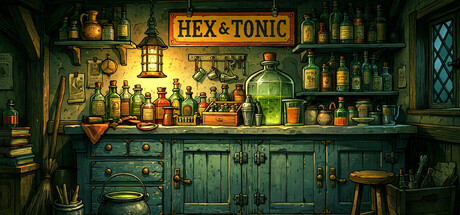
I am a professional artist who lost the majority of my vision many years ago. Now legally blind, I use AI to generate base images and I create what I call "Hybrid Art", in which I combine my own art and skills with the generations to still create art that I love. This technique has been used in Hex & Tonic for card art, store page art, etc. I hope it brings you as much joy as I got creating for you.
This game's text localization into multiple languages was assisted by AI translation tools. Three background music tracks, licensed from Pixabay, were AI-created or AI-modified by their original creators. All other artwork, audio, and game assets are human-made or sourced from licensed marketplaces — no other AI-generated content is used.
Generative AI tools were used during development to enhance and refine certain images which included improving resolution, clarity, colour. No AI-generated content is created during gameplay.