Public Steam disclosure research27,951 disclosures tracked
Where do games disclose AI use?
Search developers’ Steam disclosures, compare classified AI use across
games, and follow recorded changes.
This index adds cross-game classifications and statistics to
statements published on individual store pages.
Groups reflect automatic analysis of public disclosures; mature records are excluded. These counts do not measure AI use across all of Steam.
Missing or unclear statements cannot establish whether a game uses AI.
Some visual concept references in this game were created using AI tools during the early design phase. All final game assets were manually created, customized, and refined by our development team. No AI-generated content is used directly in the final product.
Part of the art assets were generated using AI tools to create initial concept sketches, which were then manually adjusted and revised by artists. The final work combines AI-generated foundational designs with human artistic revisions.
The translation process for languages other than Chinese utilized AI & human revision.
Some in-game content, such as simulated chat spam and cutscene art in WISH (as befits the narrative) was created with the assistance of AI powered tools.
Some of the store artwork (Steam capsules) are designed with assistance of generative AI.
The game itself - includding the music, levels, code and all artwork - is "hand made" without any of this AI stuff.
Angel Guardian has been in development for over eight years, long before the rise of modern generative AI. During that time, more than 150 artists, designers, programmers, musicians, writers, and other contributors have helped shape its world.
As development evolved, we incorporated AI tools into parts of our creative pipeline including story development, dialogue iteration, enemy balancing, difficulty tuning, concept art exploration, animation prototyping, music experimentation, and voice prototyping to accelerate iteration and explore ideas more efficiently.
Every AI-assisted asset and system was reviewed, directed, refined, or recreated by our development team. AI was one tool among many used to help bring our long-standing vision to life.
GenAI is used to create 2D character design concepts as reference images for 3D modeling.
It is also used for some UI icons, a limited number of 3D asset models, and translation of in-game character dialogue.
Some AI tools were used as part of the creative process to assist with brainstorming, polishing text, and improving efficiency in content creation. However, all final assets, visuals, and materials are manually reviewed, edited, and finalized by the development team to ensure original quality and consistency with the game’s vision.
No, the game does not use AI to generate content or code in real time during gameplay. All gameplay logic, assets, and mechanics are fully pre-defined and designed by the development team.
AI is used only for traditional gameplay elements such as enemy behavior, pathfinding, and combat decision-making. These systems are entirely pre-programmed and do not involve generative AI. The goal is to provide challenging, reactive encounters that feel dynamic and engaging for the player.
AI-generated art was developed based on original sketches and artwork created in our studio. We used a private LLM trained exclusively on our own original artwork to iterate and experiment with various visual concepts before finalizing our artistic direction. This process allowed us to efficiently explore creative possibilities while ensuring the final art assets remained true to our unique vision and aesthetic. AI was also assistive in code and project management.
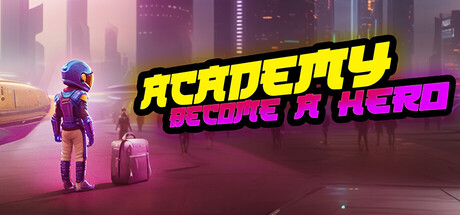
Generative AI tools were used during the development of Academy: Become a Hero to create and refine several game assets. The disclosure of its use is as follows:
2D Art and User Interface: All 2D illustrations, UI elements, icons, and menus (including upgrade screens, stage selection, and customization menus) were generated using AI tools and subsequently edited and refined for final integration.
3D Modeling: The main character (Troid) and its skeletal meshes were created using Meshy. We hold a valid commercial license for all content generated and used in the project.
Localization: Game localization and translations into all supported languages were performed with the assistance of AI large language models to ensure global accessibility.
Audio and Voiceovers: For the introductory cinematic, AI was utilized to modulate and process the developer's original voice recordings to create distinct and characterized voices for the different characters.
All AI-generated content has been manually reviewed, corrected, and finalized by the developer to ensure artistic consistency and technical quality.
Generative AI was used to partially create the background images on the marketing assets.. The game itself is hand-crafted, hand-drawn, and animated by a human hand!
The game is a research project into how the use of AI would affect game production, so AI has been used for images, voiceovers, code, dialogue and other areas as much as possible. Just to see what sort of results it provides.
We generated drafts for the game's and company logos, part of the capsules art, the voice in the trailer and the store texts. Then we adapted them to our liking.
AI-generated story invention
AI generated audios
AI-generated translation
AI generated videos
AI generated images
This game use AI Art. Special Thanks to the following Creators of...
KLING AI (Videos)
Wonder AI (2D Graphics)
Runway AI (Trailer Voice)
Chat-GPT / OpenAI (Translation)
DALL-E (2D Graphics)
Replica AI (Voice)
Meshy.ai (3D Models)
Creator
Playbosh Games Entertainment UG (haftungsbeschränkt)
Human creation and the use of AI :
➧ 100% of the game's sounds were purchased and designed by humans.
➧ 100% of the animations VFX were purchased and designed by humans.
➧ 100% of the interface was designed, customized, and integrated by me over more than two years of meticulous, case-by-case attention, representing thousands of hours of work. These interface elements come from numerous resource packs purchased online from human artists such as Kodiac Graphics and his amazing Mercenary GUI https://kodiakgraphics.itch.io/mercenary-rpg-gui or PONETI and his 4000 icons https://poneti.artstation.com/store/zVzR/4000-fantasy-icons or PVGames and his trully unique 2D Srpites used as cosmetic in-game coat of arms appearances, REXARD https://assetstore.unity.com/publishers/13229 Dream Circle for hundreds of incredible animations vfx https://dreams-circle.itch.io/ And many more !
Generative AI was used to create backgrounds images such as class backgrounds, menu backgrounds, battle backgrounds. I recently updated the sprites of all the enemies in the game using generative AI; the retro 3D rendering is incredible and perfectly matches the art style.
All this represents approximately 15% of the game's graphics assets. But this was done carefully and sparingly, and in conjunction with human work and my artistic direction.
➧ 100% of the game's music was made by humans
15 Soundtracks by Alexander Nakarada
1 Soundtrack by Wolfgang Muermann
26 Soundtracks by Alkakrab
Borrowhelen uses AI only for generating and synthesizing character voices and for checking typos. All other content (graphics, music, levels, etc.) is 100% human-made.
AI was used to reduce time investment in illustration art. The AI art can be seen in various UI elements where illustrations are present. Please note, all of the AI art you see wasn't merely generated and thrown into the game, it obviously needed a fairly extensive degree of retouching.
I used AI tools during development to help with code optimization, solve problems like pathfinding and mathematical formulas, and assist with English translation and proofreading.
During the development phase, some placeholder voices and vocal prototypes are generated using AI tools. These are used solely for iteration, testing, and internal production workflows.
For the final release, all characters will be voiced by professional voice actors.
A majority of the static image content, the character portrait animations in the Character Select screen, and some flavor text on playable cards, had AI play a role in their development.
Some notable exceptions to this are:
The card frame artwork for all cards, which were created by a contracted artist.
Our capsule and header images, which were created by a contracted artist.
Some enemy portraits.
Marketing materials which include artwork from the capsule and header.
All narrative and dialogue text, which was written by the team.
We would like to extend a special thank you to the select family and friends who volunteered their likenesses for use as models for some of our main characters. It is deeply appreciated and we enjoyed working with you.
I will not directly provide any AI services, but plan to only retain the interface for external AI to take over the game logic in the game. Users can use their own trained language models, and they can only solve problems such as computing power by themselves. I plan to not allow users to enter text in the game, so that users have no chance of inducing language model generation. However, some overfitting language models will ignore the prompts and output nfsw. At the same time, I used two methods: 1. Limit the output length and suppress it from the root. 2. Keyword check to see if nfsw content exists. If someone tries to report it, he should report it to the person who gave him the language model. If the user enables AI, I will change the name of the enabled AI service into a game watermark to prove that it is the user's own problem.
AI-assisted tools may also be used during development for temporary voice-over drafts, sound exploration, and visual concept iteration, strictly as part of the production workflow.
Final voice acting, sound effects, music selection, visual assets, and UI elements are curated, edited, or replaced by the developer before release to meet quality, consistency, and licensing standards.
No AI systems generate live audio, voices, images, or visual content during gameplay.
All final in-game audiovisual content is authored, validated, and intentionally integrated into the game experience.
AI tools were used during the pre-production phase to generate concept art and visual references to help establish the game's atmosphere and mood. All final in-game assets were created or modified by our development team. No AI-generated content is created in real-time during gameplay.
Some visual concept references in this game were created using AI tools during the early design phase. All final game assets were manually created, customized, and refined by our development team. No AI-generated content is used directly in the final product.
Part of the art assets were generated using AI tools to create initial concept sketches, which were then manually adjusted and revised by artists. The final work combines AI-generated foundational designs with human artistic revisions.
The translation process for languages other than Chinese utilized AI & human revision.
Some in-game content, such as simulated chat spam and cutscene art in WISH (as befits the narrative) was created with the assistance of AI powered tools.
Some of the store artwork (Steam capsules) are designed with assistance of generative AI.
The game itself - includding the music, levels, code and all artwork - is "hand made" without any of this AI stuff.
Angel Guardian has been in development for over eight years, long before the rise of modern generative AI. During that time, more than 150 artists, designers, programmers, musicians, writers, and other contributors have helped shape its world.
As development evolved, we incorporated AI tools into parts of our creative pipeline including story development, dialogue iteration, enemy balancing, difficulty tuning, concept art exploration, animation prototyping, music experimentation, and voice prototyping to accelerate iteration and explore ideas more efficiently.
Every AI-assisted asset and system was reviewed, directed, refined, or recreated by our development team. AI was one tool among many used to help bring our long-standing vision to life.
GenAI is used to create 2D character design concepts as reference images for 3D modeling.
It is also used for some UI icons, a limited number of 3D asset models, and translation of in-game character dialogue.
Some AI tools were used as part of the creative process to assist with brainstorming, polishing text, and improving efficiency in content creation. However, all final assets, visuals, and materials are manually reviewed, edited, and finalized by the development team to ensure original quality and consistency with the game’s vision.
No, the game does not use AI to generate content or code in real time during gameplay. All gameplay logic, assets, and mechanics are fully pre-defined and designed by the development team.
AI is used only for traditional gameplay elements such as enemy behavior, pathfinding, and combat decision-making. These systems are entirely pre-programmed and do not involve generative AI. The goal is to provide challenging, reactive encounters that feel dynamic and engaging for the player.
AI-generated art was developed based on original sketches and artwork created in our studio. We used a private LLM trained exclusively on our own original artwork to iterate and experiment with various visual concepts before finalizing our artistic direction. This process allowed us to efficiently explore creative possibilities while ensuring the final art assets remained true to our unique vision and aesthetic. AI was also assistive in code and project management.
Generative AI tools were used during the development of Academy: Become a Hero to create and refine several game assets. The disclosure of its use is as follows:
2D Art and User Interface: All 2D illustrations, UI elements, icons, and menus (including upgrade screens, stage selection, and customization menus) were generated using AI tools and subsequently edited and refined for final integration.
3D Modeling: The main character (Troid) and its skeletal meshes were created using Meshy. We hold a valid commercial license for all content generated and used in the project.
Localization: Game localization and translations into all supported languages were performed with the assistance of AI large language models to ensure global accessibility.
Audio and Voiceovers: For the introductory cinematic, AI was utilized to modulate and process the developer's original voice recordings to create distinct and characterized voices for the different characters.
All AI-generated content has been manually reviewed, corrected, and finalized by the developer to ensure artistic consistency and technical quality.
Generative AI was used to partially create the background images on the marketing assets.. The game itself is hand-crafted, hand-drawn, and animated by a human hand!
The game is a research project into how the use of AI would affect game production, so AI has been used for images, voiceovers, code, dialogue and other areas as much as possible. Just to see what sort of results it provides.
We generated drafts for the game's and company logos, part of the capsules art, the voice in the trailer and the store texts. Then we adapted them to our liking.
AI-generated story invention
AI generated audios
AI-generated translation
AI generated videos
AI generated images
This game use AI Art. Special Thanks to the following Creators of...
KLING AI (Videos)
Wonder AI (2D Graphics)
Runway AI (Trailer Voice)
Chat-GPT / OpenAI (Translation)
DALL-E (2D Graphics)
Replica AI (Voice)
Meshy.ai (3D Models)
Playbosh Games Entertainment UG (haftungsbeschränkt)
Human creation and the use of AI :
➧ 100% of the game's sounds were purchased and designed by humans.
➧ 100% of the animations VFX were purchased and designed by humans.
➧ 100% of the interface was designed, customized, and integrated by me over more than two years of meticulous, case-by-case attention, representing thousands of hours of work. These interface elements come from numerous resource packs purchased online from human artists such as Kodiac Graphics and his amazing Mercenary GUI https://kodiakgraphics.itch.io/mercenary-rpg-gui or PONETI and his 4000 icons https://poneti.artstation.com/store/zVzR/4000-fantasy-icons or PVGames and his trully unique 2D Srpites used as cosmetic in-game coat of arms appearances, REXARD https://assetstore.unity.com/publishers/13229 Dream Circle for hundreds of incredible animations vfx https://dreams-circle.itch.io/ And many more !
Generative AI was used to create backgrounds images such as class backgrounds, menu backgrounds, battle backgrounds. I recently updated the sprites of all the enemies in the game using generative AI; the retro 3D rendering is incredible and perfectly matches the art style.
All this represents approximately 15% of the game's graphics assets. But this was done carefully and sparingly, and in conjunction with human work and my artistic direction.
➧ 100% of the game's music was made by humans
15 Soundtracks by Alexander Nakarada
1 Soundtrack by Wolfgang Muermann
26 Soundtracks by Alkakrab
Borrowhelen uses AI only for generating and synthesizing character voices and for checking typos. All other content (graphics, music, levels, etc.) is 100% human-made.
AI was used to reduce time investment in illustration art. The AI art can be seen in various UI elements where illustrations are present. Please note, all of the AI art you see wasn't merely generated and thrown into the game, it obviously needed a fairly extensive degree of retouching.
I used AI tools during development to help with code optimization, solve problems like pathfinding and mathematical formulas, and assist with English translation and proofreading.
During the development phase, some placeholder voices and vocal prototypes are generated using AI tools. These are used solely for iteration, testing, and internal production workflows.
For the final release, all characters will be voiced by professional voice actors.
A majority of the static image content, the character portrait animations in the Character Select screen, and some flavor text on playable cards, had AI play a role in their development.
Some notable exceptions to this are:
The card frame artwork for all cards, which were created by a contracted artist.
Our capsule and header images, which were created by a contracted artist.
Some enemy portraits.
Marketing materials which include artwork from the capsule and header.
All narrative and dialogue text, which was written by the team.
We would like to extend a special thank you to the select family and friends who volunteered their likenesses for use as models for some of our main characters. It is deeply appreciated and we enjoyed working with you.
I will not directly provide any AI services, but plan to only retain the interface for external AI to take over the game logic in the game. Users can use their own trained language models, and they can only solve problems such as computing power by themselves. I plan to not allow users to enter text in the game, so that users have no chance of inducing language model generation. However, some overfitting language models will ignore the prompts and output nfsw. At the same time, I used two methods: 1. Limit the output length and suppress it from the root. 2. Keyword check to see if nfsw content exists. If someone tries to report it, he should report it to the person who gave him the language model. If the user enables AI, I will change the name of the enabled AI service into a game watermark to prove that it is the user's own problem.
AI-assisted tools may also be used during development for temporary voice-over drafts, sound exploration, and visual concept iteration, strictly as part of the production workflow.
Final voice acting, sound effects, music selection, visual assets, and UI elements are curated, edited, or replaced by the developer before release to meet quality, consistency, and licensing standards.
No AI systems generate live audio, voices, images, or visual content during gameplay.
All final in-game audiovisual content is authored, validated, and intentionally integrated into the game experience.
AI tools were used during the pre-production phase to generate concept art and visual references to help establish the game's atmosphere and mood. All final in-game assets were created or modified by our development team. No AI-generated content is created in real-time during gameplay.