Public Steam disclosure research28,028 disclosures tracked
Where do games disclose AI use?
Search developers’ Steam disclosures, compare classified AI use across
games, and follow recorded changes.
This index adds cross-game classifications and statistics to
statements published on individual store pages.
Groups reflect automatic analysis of public disclosures; mature records are excluded. These counts do not measure AI use across all of Steam.
Missing or unclear statements cannot establish whether a game uses AI.
Portions of this game's content were created with generative AI assistance under human direction and review: in-game text (social feed posts, event copy), localization into 8 languages, and marketing materials including the trailer. All AI-assisted content was reviewed by the developer. The game does not generate AI content at runtime.
Art assets (pre-generated): In-game scene backgrounds, UI icons, and store page promotional images are generated using Doubao as initial drafts. After manual screening, modification, and style unification, they are packaged into the game. All AI-generated art assets have been reviewed manually one by one, confirming that they do not contain any violations such as violence or pornography, and no copyrighted third-party assets have been used as input for generation. The AI tools used all have commercial use licenses.
Code (pre-generated): Some game logic code is generated with AI assistance during the development stage. After manual review, testing, and modification, it is compiled and packaged. The game does not call AI to generate code in real-time during runtime.
During the game's runtime, there is no AI-generated content in real-time. All AI-generated content visible to players are pre-generated static resources.
Generative AI tools were used to assist in the creation of marketing artwork and store page assets. All game content is procedurally generated through Thalyn's proprietary algorithms
This game uses AI-assisted tools solely for programming and logic development. AI helped generate some basic code frameworks, but all core game logic was manually written, tested, and optimized.
Some Steam store graphical assets for VN Engine 2D, such as capsule and library artwork, may have been created with AI assistance and were manually reviewed before submission.
VN Engine 2D is a desktop editor for creating 2D visual novels and interactive story projects. The Steam build does not include player-facing live AI generation, does not connect to external AI services during use, and does not require users to enter third-party API keys or pay for AI services outside of Steam.
P·A·L - Personal Artificial Lifeform is a generative AI software suite. P·A·L generates written word, spoken word, voice to text, generative images, generative music and sound, game code, and is capable of learning through user choices.
Always use AI responsibly.
Connects to 3rd-Party Service for AI Content Generation: Hugging Face
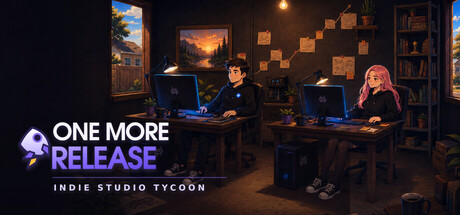
Generative AI tools were used during development to create and refine some pre-generated visual assets, including character illustrations, office environments, decorative objects, and promotional artwork. All generated materials were manually selected, edited, integrated, and reviewed by the developer. The game does not generate any AI content while running.
Some visual assets and promotional materials included with this application were created or refined using generative AI tools. All AI-generated content has been reviewed, edited, and curated by the developer before being included in the product. The application does not generate AI content during runtime.
We want to be 100% clear: this software does not generate AI artwork. All animation, rendering, and creation tools are powered entirely by traditional algorithmic code.
The use of AI is strictly limited to:
• Text Localization: Assisted translations for store and interface text.
• Legacy Shape Detection: An optional, legacy computer-vision model that can be toggled on solely to assist with detecting edges and outlines. It does not generate art from prompts or models, and can be completely ignored in favour of our standard, non-AI outline tools.
We used generative AI tools in a few clearly defined parts of this project, and we want to be upfront about where.
During development, we used AI coding assistants to help write and review parts of the source code, the same way many modern studios use these tools. We also used generative AI to help create some of the store page and marketing assets, such as promotional images and parts of the written copy. Everything produced this way was checked, edited, and approved by us before it went live.
Inside the app itself, the background removal feature runs on machine learning models to cut backgrounds out of images that you choose to load. These models only process the images you give them, on your own machine, and nothing is generated or sent anywhere without your action.
The core gameplay experience, meaning the overlays you place, the cursor effects, the pinning behavior, and the audio reactive features, is built from regular code and does not generate content with AI at runtime. Any HTML overlays you get from the Steam Workshop are made and shared by other users, so their content is up to whoever created them.
We do not use AI to generate live content that changes on its own while you use the app, and we do not train models on your data.
FragMend is a local video-conversion utility. The application itself contains no AI-generated content and uses no generative AI at runtime, your recordings are processed entirely on your own PC by ffmpeg, with no AI involved and nothing uploaded.
Some of the text on this store page and related marketing copy was drafted with the help of a generative AI writing assistant, then reviewed and edited by the developer for accuracy. The app's logo and capsule/library artwork are generated programmatically by the developer's own code (procedural rendering), not by generative AI.
PyxelAid includes optional AI-assisted image processing filters that users can apply to their own imported images. These filters may enhance, clean, upscale, simplify, recolor, or restore pixel-art images based on the user's input. The app does not generate text, code, dialogue, or autonomous content during use. Users control the input images and decide whether to save or share the resulting outputs.
The store page was originally written in Chinese. All other language versions, including English, were translated using AI (the same engine the product itself uses), then reviewed by a human before publishing. No other store assets are AI-generated.
This game uses pre-generated AI-assisted content.
Most of the visual assets used in the game and its promotional materials were created with the help of generative AI tools, including character images, background images, key visual materials, and video/trailer assets.
All AI-assisted outputs were reviewed, selected, edited, and integrated by the developer before being included in the game. The game does not generate AI content in real time during gameplay.
VoxelForge includes local generative AI features for user-assisted 3D and voxel asset creation.
Users can provide their own source images and use the application to generate 3D models, voxel assets, meshes, textures, and related production assets. This generation runs locally on the user’s computer using model files bundled with the application.
VoxelForge does not connect to an external AI service during normal use. It does not require a Hugging Face account, API key, cloud generation service, or external server connection at runtime. User input images and generated outputs are not uploaded to our servers.
The AI features are intended as creative tools for asset production. Users are responsible for ensuring that they have the necessary rights to any images or source material they import, and for reviewing generated outputs before using or distributing them.
All visual artwork in Altus Chess: Archaic Beginnings — piece designs, board and background art, and promotional/store imagery — was created using generative AI image tools, directed by the developer through human-written prompts based on the game's own pieces and concepts, then reviewed and edited by hand. No content is generated live during gameplay. The game's opponent is a proprietary, hand-built algorithmic chess engine, not generative AI.
AI is used on an ad hoc basis for: 3D model texturing, code assistance, and references for asset modeling. It does not affect gameplay or interactive content.
Elftia is an AI agent platform. Through an included service, it connects to leading third-party AI models - large language models and image, video, music and speech generators - to power its agents. Elftia does not bundle, train or fine-tune any model of its own; all content is generated in real time by those models in response to the user's input. New users receive free starter credits, and additional usage can be purchased through Steam. Conversations and generated content are saved to the user's local library on their device.
bossMAN uses generative AI for user-directed agentic project work, including planning, writing and reviewing code, documentation and other text. It supports ChatGPT through Codex, Claude and compatible local models.
The app includes Codex, Claude and local inference runtimes and speech components. Hosted AI requires your own eligible provider subscription and internet access; subscriptions and AI credits are not included. Local AI requires compatible model files and suitable hardware; local chat-model files are not included.
AI output can be incorrect or unsuitable. Agents can change files and run commands under your access and approval settings. Content safeguards depend on the selected provider or user-configured local model. bossMAN supports configurable guidance to help direct agent behavior. Review generated work and changes, keep backups, and check applicable rights and licenses before use or distribution.
Connects to 3rd-Party Service for AI Content Generation: OpenAI Codex (ChatGPT), Anthropic Claude, and compatible local models
CrowForge does not include any pre-generated AI content in the product
itself. The application is a workspace tool — all AI-generated content
is created by the user during their own sessions using their own prompts
and chosen AI models.
Hagicode is a software tool for code development that interfaces with third-party CLI tools. Accordingly, it invokes third-party CLI tools for content generation. These CLI tools, including Claude Code, Codex, Gemini CLI and others, are installed and used by users on their own computers independently.
Users utilizing these CLI tools are generally professional developers. Hagicode does not invoke any third-party AI generation services other than the aforementioned CLI tools. It merely acts as a caller to coordinate and display outputs returned by the CLI tools.
Therefore, Hagicode shall not be liable for the generated results and content. Hagicode is not the actual generator and implementer, but only a caller.
NeuralBeat Studio is an audio and music production software that uses local offline artificial intelligence models including custom Transformer neural networks for retro music composition and neural text-to-speech engines for voice dialogue. All AI generation occurs directly on the user's computer in real time to help creators design original music, sound effects, and voiceovers for their video game projects. All generated audio is original, royalty-free, and suitable for commercial game development.
Name of AI model included with the game: Custom Local Neural Models: Transformer (Retro Music Composition) (Neural Speech Synthesis), and NeuralBeat Procedural DSP Audio Engine. All models run 100% locally on the user's PC.
Generative AI is used as a translation aid for some in-app text and the English localization of the store page.
This application does not include any features that use generative AI.
Some store trailer audio, including voice and music, was generated or assisted by generative AI. The application itself does not include AI-generated assets and does not generate AI content during use.
AI tools were utilized during the development process to assist with code optimization, debugging, and the implementation of core system architectures. All code and logic generated by AI have been manually reviewed, verified, and integrated into the final build by the developer to ensure stability and policy compliance.
Wallpaper Animator uses generative AI. An in-app AI assistant creates wallpapers from your descriptions, edits them, and animates them into looping videos, using third-party AI services and our own servers.
Connects to 3rd-Party Service for AI Content Generation: OpenAI
Divooka is primarily handcrafted, next-generation software and does not rely on AI-generated content as part of the user-facing experience.
Generative AI is used selectively within the development process in the following areas:
- Refinement of marketing materials (written content, visual compositions)
- Research and prototyping during R&D phases
- Limited graphical asset generation (e.g., icons, non-core UI elements)
- Localization support (translation and adaptation of text)
No AI-generated content is directly shipped as part of the core software experience.
As a programming environment, Divooka provides APIs for interfacing with external generative AI services and locally hosted models. Through these APIs, users may generate content at runtime, including:
- Text (e.g., scripts, dialogue, documentation)
- Code (user-authored or AI-assisted program logic)
- Visual assets (e.g., images, textures)
- Other data depending on the connected model or service
Divooka itself does not require or depend on AI-generated content to function. All generation is user-initiated and controlled.
Connects to 3rd-Party Service for AI Content Generation: OpenAI, Grok, Gemini, DeepSeek, NVIDIA NIM
FriedrichAI uses a locally hosted AI model to provide responses, assist with coding tasks, and support general interaction.
All processing is performed on the user’s machine. The application does not rely on cloud-based AI services and does not send user data externally.
The AI generates text-based responses based on user input and is intended for productivity, development assistance, and general-purpose use.
AI-generated images and audio in the default example project, used for demonstration purposes only. It will be fully replaced with real art in one of the next updates!
This game does not use generative AI in real time.
Any generative AI content is created only in advance, in accordance with Steam's guidelines.
Programming
Generative AI tools may be used to assist with code completion, refactoring, and review. All code is subject to final human review before use.
Translations
For languages other than Japanese, AI tools may be used for translation.
Assets
Some in-game graphics and promotional images may be created with generative AI tools. All such assets are reviewed and edited by a human, and none are used as-is.