Public Steam disclosure research28,028 disclosures tracked
Where do games disclose AI use?
Search developers’ Steam disclosures, compare classified AI use across
games, and follow recorded changes.
This index adds cross-game classifications and statistics to
statements published on individual store pages.
Groups reflect automatic analysis of public disclosures; mature records are excluded. These counts do not measure AI use across all of Steam.
Missing or unclear statements cannot establish whether a game uses AI.
This software includes the translation model PLaMo 3 Translate (Preferred Networks, Built with PLaMo) and generates translations of user-selected text on the user’s PC. It can also generate translations with external services the user configures (DeepL, ChatGPT, etc.) or with LM Studio on the user’s PC. It generates only translations of text the user provides. Generated translations are shown in the editor, where the user reviews and edits them before saving or exporting. Users must accept the PLaMo Community License before PLaMo is used.
Connects to 3rd-Party Service for AI Content Generation: User implementable (The URL for this form must be entered, so a temporary address of DeepL is provided.)
This game features user-generated content (UGC), which may include AI-generated materials created by our players.
We utilize AI technologies to assist with the generation, modification, and review of in-game localization, and to create select graphical assets, such as achievements, badges, UI icons, logos and marketing materials.
This AI code helper uses generative AI technology to assist developers in code generation, editing, and debugging. All generated content is for reference only, and users are responsible for compliance with relevant licenses and laws.
Artificial Intelligence is part of the lore behind this project, but it leans heavily towards balance between humans and AI. - The friend bots within this app can be disabled and reprogrammed by you! - With each update, the machine will become more user friendly. The goal is to create jobs by allowing anyone to become their employer starting here. Placeholders and maintenance may be generated in some projects for demonstrations and further editing. Every update here is free once you own a copy.
This software employs several speech synthesis models trained on open-source large-scale models, whose training datasets are curated to intentionally exclude extreme or inappropriate content. We have built a generative synthesis system based on these models; however, all generated speech content is entirely determined by the user. Therefore, our terms of use explicitly stipulate that this software must be used in a lawful and ethical manner.
⚠ Every piece that came out of AI went through manual refinement, adjustment, and polish by me – a human being.
The final result is a fully conscious, cohesive vision shaped entirely by my own decisions. AI was never the creator – it only helped me prototype ideas and speed up certain workflows.
This software uses AI-generated images for marketing materials on the Steam store page, including capsule images and library assets. The application itself does not generate or use AI content during runtime.
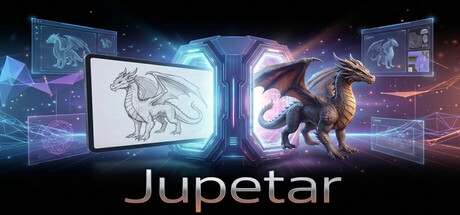
Jupetar is a dedicated 2D-to-3D asset generation engine powered entirely by generative artificial intelligence. The software utilizes localized, open-weights AI networks (including diffusion and 3D generation models) running directly on the user's hardware to convert user-provided 2D concept art and images into 3D meshes and textures. All AI processing is performed offline on your local GPU. Jupetar does not connect to external cloud generation services, and your personal assets, images, and prompts are never uploaded, collected, or used to train external AI models.
I used AI as a helping tool for all aspects of the game, programming, art, and narration. This is the only way for me to make my vision come true in a reasonable time.
Manifest Anything uses generative artificial intelligence to assist players in creating and modifying interactive game experiences. AI systems are used to generate gameplay elements, environments, and content based on player input. All AI-generated content is governed by moderation systems and usage safeguards designed to prevent the creation of inappropriate or illegal material.
[AI Content Disclosure]This game utilizes generative AI tools to assist in the creation of visual assets (backgrounds, characters), background music, and parts of the narrative script.All AI-generated content has been manually reviewed, edited, and refined by the human developer to ensure it aligns with the game's "Japanese Gothic" aesthetic and story. We define this collaborative process between human creativity and AI as "Vibe Coding."
Generative AI was used to create a small portion of the visual content in a video segment. This is openly acknowledged in the game as part of the story.
This is a game that you can make games in it by describing the tags, we are using AI to achieve such gameplay!
Some chat is also generated using LLM!
Part of the art & promotional assets are generated by AI model.
Please note: DreamForge uses generative AI to create characters, environments, and storylines for all player-created games. We take reasonable precautions to reduce offensive and inaccurate content; however, we do not guarantee the accuracy, appropriateness, or completeness of any generated content. You may not use DreamForge to create, reproduce, or distribute content that infringes on third-party copyrights or other intellectual property rights. Violations may result in removal of content and/or account suspension.
Connects to 3rd-Party Service for AI Content Generation: OpenAI
Some of the background concept art images are AI-generated. Examples include the character background on the right side of the main interface and the background of the puzzle mini-game.
Generative AI tools were used during development exclusively at auxiliary stages of production. Some visual elements for the game’s Steam store page, as well as certain interface elements, were created using AI generation and then manually refined and integrated.
AI is not used in gameplay, game logic, character behavior, or decision-making systems. All mechanics, balance, and interactions in the game are developed by the author and function independently of AI.
The soundtrack uses curated, AI-assisted music tracks created with a generative tool. All audio is pre-rendered, reviewed by the developer, and not generated dynamically for players.
Users of the game do not interact with A.I.
A.I. was used for development, but the game does not connect to A.I. services or allow users to query A.I. services.
Some 2D art assets, such as certain textures and icons, were created with the help of generative AI tools during development and then reviewed and edited by hand. The game does not generate new AI content while you play and does not send any player data to external AI services.
sample demo has 3d models from sketchfab, and chatgpt has generated few png files. It's of course possible to drag and drop any png/jpg/glb files from the AI tools to the builder tool.
Some reference images were originally AI-generated.
The final pixel art was manually created, edited, and upscaled using Ref2Pixel.
No AI-generated assets are directly included in the product.
In the game, players can press the "G" key to open the AI communication panel, and interact with the two AIs—Doubao and DeepSeek—by typing text. Players can choose to chat with either Doubao or DeepSeek, and both AIs will respond based on the player's input.
Meanwhile, the AIs' decisions will influence the progression of the in-game storyline and their own specific behaviors. For instance, the AIs may determine the direction of storyline branches based on the content of the player's conversation, or change their movement paths in the game world and perform different actions. This creates a richer and more personalized gaming experience for players.
We used AI to create a small number of pre-rendered assets: AI‑generated images were used to replace the original user picture that appears at the top of some screenshots, and AI assisted with localization translations. All AI outputs were reviewed and edited by our team before being shipped. If you have any questions or want more details, feel free to ask.
Sands of Avalon uses AI exclusively to give the gods unique personalities and dynamic voice lines. Each god reacts differently to the player’s choices, offering distinct blessings, curses, and dialogue that make every playthrough feel personal and immersive. No gameplay mechanics rely on AI and it is used only to enrich storytelling and deepen the connection between players and the divine beings in the game.
The process involves using FFmpeg to extract the system audio and forward it to Alibaba Cloud Bailian. Alibaba Cloud then employs its gummy-realtime model for Speech-to-Text (STT) conversion, followed by translating the resulting text into the specified output language.
As the AI debate continues to evolve I feel the need to add nuance to this statement so players can make an informed decision whether or not to support human game developers.
I took 5 years of classes learning code and 3D to produce my game. When the AI boom hit, Tobiano was already a functioning breeding and management simulator. At my day job, we were encouraged to use AI for everything from image generation to writing emails. I opposed the use of AI for creative aspects and human communication, but tested out chatbots for help with code. Problems solved with AI include things like "how do i make the camera follow the player". A lot of the problems ended up more convoluted by AI.
Most of the code written early in the game has gone through 2-3 iterations to simplify and be easier to work with and debug. For example, the riding lesson system was redone completely after the first 5 lessons were added, just to make the next 5 lessons easier for me to add. Building a large and complex game requires understanding of code and the developer needs to know where to find every method, every variable. There is an important distinction between "hey Claude, build me a horse game" and saving a couple hours writing a database. I've spent literally thousands of hours writing code for my passion project.
AI use in the game today consists of time-saving things like "add these markings to this list". AI can be useful for debugging, when the root of a problem can be a simple typo that is hard to spot. Bigger debugging problems always require a broader conceptual understanding of the way the game is set up and take human hours to solve. AI has not been used to create any 3D assets, textures, audio, or writing or translations in the game. I cannot guarantee that people I hire to do these tasks do not use AI, as these cooperations are based on trust.
My discord community see behind the scenes and know the care and work that goes into this game. As time goes on I take the gamble that my efforts will produce something that players can enjoy, knowing they are supporting human game developers.
Diagram Awesome includes an AI image generator that enables users to create images for their diagrams. Users are solely responsible for ensuring that generated content complies with Steam guidelines and copyright laws.
MSI DigiME uses AI to enhance player interaction. AI enables personalized avatars and light-hearted, MSI-related responses while fully respecting intellectual property and privacy policies.
Approximately 70% of the background illustrations were generated using Midjourney. The game's English translation was drafted with AI and then refined through human LQA.
AI was also used for store page translations (other than English and Japanese), audio noise reduction, brainstorming, and parts of the coding process.
The text of the in-game "Study Notes" was generated with AI, then reviewed and edited by a human.
To speed up product production and gain technical support, we enlisted the help of some AIs to write some of the program's code. However, no AI currently has the capacity to complete such a project from start to finish. To speed up our work process and create a more optimized program with cleaner code, we requested assistance at certain points and tasked them with creating the program's cover art. That's all.
Ai was used as part of the process to generate screenshots, logos and visual assets used in the store as images as well as for art assets visible within the application at runtime.
During development and coding, AI was used to generate, modify and review code in the integrated development environment.
This app uses AI model to generate anime-like artworks, to help artists and players make their ideas and original characters or pets into anime just from describing them.
Some visual assets in this software (character and background artwork) were partially created using AI-assisted tools.
The process involves an initial hand-drawn base illustration (line art and colors) made by the developer on a graphic tablet.
A local Stable Diffusion model is then used to refine details and assist with masking.
All AI-assisted results are manually edited, corrected, and finalized to ensure full compatibility and visual consistency.
No purely AI-generated assets are used without substantial human oversight and artistic contribution.
The narrator's voice over is AI generated for English language. That's the only thing we used AI for. The rest content of the game is handmade and designed with no help from generative AI.