Public Steam disclosure research27,951 disclosures tracked
Where do games disclose AI use?
Search developers’ Steam disclosures, compare classified AI use across
games, and follow recorded changes.
This index adds cross-game classifications and statistics to
statements published on individual store pages.
Groups reflect automatic analysis of public disclosures; mature records are excluded. These counts do not measure AI use across all of Steam.
Missing or unclear statements cannot establish whether a game uses AI.
Some in-game visuals (UI elements and sprites) and promotional materials in ZOMBIE DESTROYER were created with the help of generative AI tools before release. All of this content was reviewed and edited by the developer. No content is generated by AI during gameplay.
Several of the models in the game are generated with AI, often originated in own art.
Game is co-created with generative AI.
There is a 'My AI' feature in the game, where you can send out a bot to play games for you and it is trained on games you play. The function used is a simple softmax, not advanced LLM, and this is hosted privately.
- Graphics in the game are human-made, however, some of those are color-graded and re-coloured with AI tools.
- All in-game text is proof-read by AI to safeguard against typos and grammar issues.
- Sound and music volume(db) balance, as well as mixer balance, was handled by AI tools.
Generative artificial intelligence has been used as an assistive tool to create the static 2D portraits of the gladiators and the background illustrations for the user interface. All generated assets have been manually supervised, filtered, and edited by the developer to ensure they perfectly fit the historical setting and the visual style of the game.
Galactic Tenebris Company believes in being transparent with the people who play our games. Here is an honest account of where AI tools contributed to this production:
— Some icons and UI elements, texturres
— Organizing and structuring text and documents.
— Translation
All 3D models were handcrafted by the developer. The music and sound effects were composed and not generated by AI tools.
Our position as a company is simple — we use AI only where we have no other means or resources available. Where human craft was possible, human craft was used.
Every creative decision — the story, the world, the characters, the quests, the writing — was made by the developer. The scenario and dialogues were authored by the developer and organised with AI assistance. The foundation of this game is firsthand experience. That part was not written by any tool.
— Mr. M., Owner of Galactic Tenebris Company
The developer wrote the game text together with AI tools and translated it into 14 other languages with AI assistance. Every line is reviewed by the developer before release. The background music and some floor textures started as generative AI output; the textures were then reworked by the developer. Nothing in the game is generated by AI while you play.
Generative AI tools were used during development to create images, 3D models and voices included in the game. The Steam version uses prerecorded voices only and does not generate AI content during gameplay.
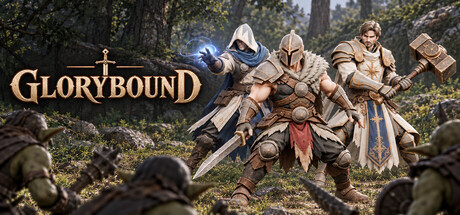
Glorybound was made with the help of generative AI tools during development. All 2D art (interface art, icons, portraits and store images) was created with AI image generation. The 3D models of the characters, monsters and bosses were generated with AI, then rigged, animated and adjusted by the developer. The music and sound effects were also generated with AI. Parts of the in-game and store text were written with AI assistance, and the Chinese, Russian, German and Spanish translations were made with AI. All AI content was created during development and checked by the developer. No AI is used while the game is running.
Generative AI tools were used during development to help create selected artwork and 3D assets, and to draft and revise some dialogue and descriptive text. Some spoken dialogue uses AI-generated voice recordings. Selected instrumental music was composed with AI assistance and rendered into audio during development. These assets are prepared in advance and included with the game. The game does not generate AI content or connect to AI services during gameplay.
Foldbound was made with the help of an AI coding assistant. The game's code was written with it, and that code generates the game's art, animation, sound effects and music procedurally. No AI image, audio, voice or video generators were used, and there is no scraped or third-party artwork; the only outside assets are openly licensed fonts. The game does not generate any content with AI while it runs.
One Steam store screenshot was cleaned up and enlarged with an image model. Fat Cat Cruz does not generate images, text, or code with AI while you play, and it does not connect to an outside AI service.
Some visual assets and marketing materials for Pixel Xanxia are created with the assistance of generative AI tools. These assets are selected, edited, integrated, and adjusted by the developer to match the game's visual direction. No live-generated AI content is used during gameplay.
Burn It Back is a solo project, designed and directed entirely by me. I use Claude as a coding assistant: I plan the systems, the AI helps write the code, and I review and debug everything myself. This includes the procedural scripts that build the game’s 3D models in Blender and some of the vector-based UI elements, so no AI image or 3D-model generators are used. Some unit voice lines are currently placeholder text-to-speech, and I plan to replace them with a real voice actor before release.
Generative AI was used to create some pre-generated music tracks currently included in the game. These tracks are intended as temporary assets and may later be replaced by music created by a professional composer. Generative AI was also used to assist with localization into languages not spoken by the development team.
Promotional artwork (capsules, banner) was created with the help of generative AI tools. The game’s code was written with AI assistance. 3D models, maps, sounds and music are produced by that code (procedural generation), with no AI-generated assets. No content is generated by AI during gameplay.
One More Coin is a solo-developed project born from my love of classic arcade games. As a solo developer, generative AI tools have helped me bring ideas to life on a scale I could not have achieved alone.
These tools assisted in creating environments, character sprites, and transition illustrations. I selected and integrated these assets into the game, shaping them around its visual style and gameplay.
For me, AI has been a tool to help turn a personal passion into a game I can share with others. All AI-generated content is prepared during development; no content is generated live while playing.
This game contains certain art assets created with the assistance of generative AI during development, including card backgrounds, skill icons, and promotional materials. All relevant content has been curated, edited, composited, and reviewed by the developer.
Generative AI is not used to generate content while the game is running. The in-game combat and team-building AI rely on local rules and algorithmic systems, without connecting to third-party AI services.
The in-game card art (the icons and card faces on the level-up, dawn, weapon and evolution cards) was created with an AI image generator in our own palette and edited by us; every word and number on the cards is drawn by the game's code. No AI-generated audio, music or voice: every sound is a real human recording. The game's code, including the code that builds its simple 3D shapes procedurally, was written with an AI coding assistant under the developer's direction. Store artwork (capsules, key art) was created with an AI image generator from our in-game screenshots and edited by us. Nothing is generated by AI while you play.
Tools were used during development to assist with structuring and formatting JSON data for the game's extensive item database. All generated data was individually reviewed, verified, and adjusted by the developer before implementation.
CropKeep is a pixel-art farming game where players grow crops, defend their farm from waves of increasingly strong enemies, and take on new challenges through a rebirth system.
The game is independently developed. Some background and art assets were created using AI generation tools, some assets were purchased under license, and the rest were created by the developer. AI tools were used during development to assist with writing and debugging code. The game does not generate new content at runtime.
The majority of the music tracks were created from my original sketches and references, with AI assisting in arrangement and mastering. A smaller number of tracks were generated from scratch based on author-defined tags, styles, and lyrics, followed by my manual refinement and selection. The trailer features musical fragments produced using the same AI tools.
Generative AI was used to assist in creating promotional artwork for the Steam store page, including capsule imagery and backgrounds. These assets were reviewed and edited before publication.
AI tools were used for some sound effects, for the trailer's music, and to help translate the game's text and store page into other languages.
All visuals, creatures, worlds and gameplay are created by the developer and rendered in-engine.
Generative AI tools were used during the development of Bounland as a programming assistant. All code was reviewed, adapted and tested by our team. The game does not generate any content with AI during gameplay.
Vantage Tactics is the result of years of work by a solo developer. The vast majority of art assets were purchased from several different artists. Generative AI has been used to generate art for the store page, some minor visual and sound effects, and to explore ideas and directions, and therefore has had some influence on the game design, marketing and style.
The 3D animal character models were created with the help of generative AI tools. AI tools were also used to help write game code, to translate the game and store page into other languages, and to draft store and marketing text. All of this content was reviewed and edited by the developer. No AI content is generated while you play.
Some content in Sunken Choir was created or enhanced using generative AI tools. This includes AI-generated voices for radio communications, crew members and NPCs, as well as AI-assisted in-game artwork, promotional images, store assets and selected music tracks.
AI has been used during development for HUD/Menu design and coding infrastructure as well as certain gameplay elements. No AI content is generated during gameplay.
Generative AI tools were used to assist with the creation of some in-game graphics and audio assets, as well as localization (translation) and logo design. All AI-assisted output was reviewed by the developer and modified as needed before being included in the final game.
Most of the game's final 2D artwork was created by hand. During development, AI-generated images were used mainly as rough visual references. Generative AI was also used for audio creation and in-game text translation. The game does not generate AI content during gameplay.
Sanctuary uses procedural systems to create parts of its visuals and includes AI-generated art, sound effects, and music. I personally review and curate AI-generated assets for quality and consistency with the game’s artistic direction. Assets that do not meet my standards are discarded or revised before inclusion.
(Note: Generative AI is used during development but the game does not generate new AI content during gameplay.)
AI tools were used during development to help write the story, dialogue and in-game text, to translate the game into 9 languages, and to help write store page text. All AI-assisted content was reviewed and edited by the developer. The 3D models are human-made (KayKit by Kay Lousberg, CC0), and all screenshots, trailers and store artwork are captured directly from the game itself. No AI is used while you play.
All art in the game, including characters, enemies, backgrounds and UI, was generated with AI image tools, then selected, edited and reviewed by the developer. The game's code and text, including translations, were written with AI assistants under the developer's direction. Some sound effects were generated with AI audio tools and selected by the developer. No content is generated by AI while you play.
QtMesh Games uses generative AI during development to create selected visual assets, including 3D models, characters, textures, and promotional artwork.
Many assets are produced and refined using QtMeshEditor, an open-source 3D editing application developed by the same independent developer behind QtMesh Games.
The QtMesh asset pipeline combines custom-developed software and AI-assisted workflows with integrated AI models. Development also involves building, adapting, and improving components of these tools and pipelines.
Generated assets are reviewed, edited, optimized, and integrated into the games under human creative direction. Gameplay mechanics, systems, and overall design remain developer-directed.
The current games do not generate AI content dynamically during gameplay.
Generative AI tools were used during development to code certain logic systems. Some translations were also prepared with AI assistance. No content is generated by AI during gameplay.
The trailer contains pre-generated cinematics made with Seedance 2.0. These shots are labelled "Cinématique" in the French version and "Cinematic" in the English version.
The music tracks M02 and T01_trailer were generated by the creator with assistance from Suno.
The gameplay shots are actual game footage, with only cropping, playback speed changes and cuts, and no added visual effects.
Generative AI tools were used to help draft the store descriptions and to create or edit some marketing graphic backgrounds. The game does not generate AI content during gameplay and does not connect to external AI services while running.
Triads is a microgame created myself in 2021. Every bit of the game is of my creation.
All music is human generated and well deserved credit has been given to them in the credits section of the game.
As much as I have learned countless adobe products such as Photoshop, Illustrator, and others, to create the physical game, coding eludes me. I have enough knowledge to play around, but could never succeed at the heights AI has now allowed me. I have used AI to code my game mechanics into digital form and I have to say I was quickly impressed.
We are in the birth of Star Trek level technology and I am here for it.
Carpet Combat uses purchased asset packs, music and code, supporting the developers, artists, musicians and programmers who created them.
Generative AI tools were also used during development to create character assets, interface artwork and Steam store artwork. The game does not generate AI content during gameplay.