Public Steam disclosure research27,951 disclosures tracked
Where do games disclose AI use?
Search developers’ Steam disclosures, compare classified AI use across
games, and follow recorded changes.
This index adds cross-game classifications and statistics to
statements published on individual store pages.
Groups reflect automatic analysis of public disclosures; mature records are excluded. These counts do not measure AI use across all of Steam.
Missing or unclear statements cannot establish whether a game uses AI.
Generative AI was used solely for conceptual ideas for the main artwork images of store page. The final artworks visible on store were the completely, manually reworked, only using generative AI content as reference.
This software uses DDPG and TD3 self-learning algorithms to train virtual lifeforms to control their bodies. These algorithms only learn from experiences collected by their organisms over the course of their lifetimes and use no other data.
In the future, we plan to introduce the recombination engine - a generative AI that will analyse genetic data from lifeforms based on viability and use the results to create new, more capable species of offspring, simulating an accelerated evolutionary process. User-created lifeforms may be used for this as well as those, generated by the engine. Only those lifeforms, explicitly shared by the user, will be utilized for this purpose.
Both processes are initiated by the user with their direct permission.
We use AI-assisted tools to generate a small portion of in-game visual and audio assets. These are limited to certain images and sounds, and do not affect gameplay or player experience.
Art and visual assets were created with AI-assisted tools as part of a custom development pipeline. All assets are manually reviewed, edited, and refined to meet the game’s creative vision and maintain stylistic consistency. The game does not use AI to generate content at runtime.
Some of the images on our store page were created by artificial intelligence and edits were made on the images. and some images in the game were made by artificial intelligence.
I used AI to generate translations of the game's text elements to ensure a satisfactory English version. The AI did not create or generate anything new compared to what I had manually created.
The backgrounds for the research/videos were pre-generated by AI and manually adjusted to the desired state.
Localization in all languages except Russian.
This game relies on AI to underpin its procedural image and functionality generation systems (the systems that allow for personalised creatures and their effects).
Some assets used in Casino Management Simulator were created using generative AI tools.
• NPC character models were AI-generated.
• All in-game music tracks were AI-generated.
• Some Store Page text and marketing descriptions were AI-assisted.
No live AI generation occurs during gameplay. All AI-generated assets are pre-made, reviewed, and legally owned for use in the game.
Yep, we used AI – but only to whip up some promo images for our Steam page and a few static visuals in the game. The rest? 100% human-made, with love, coffee, and probably too many late nights.
AI is exclusively utilized in the pre-generated assets, with no live-generated AI employed. Following tools are used:
Photoshop AI (main tool): Utilized for improving art, inpainting, and outpainting.
Magnific AI: Employed for creative upscaling.
Midjourney: Utilized for concept art generation of some assets. Subsequently, assets undergo a manual improvement process in Photoshop by combining different elements from the concept art to maintain a consistent art style. For robot hand animations, the process involves Spine and Adobe After Effects. Additionally, vehicles usually undergo the creation of a 3D model in Blender.
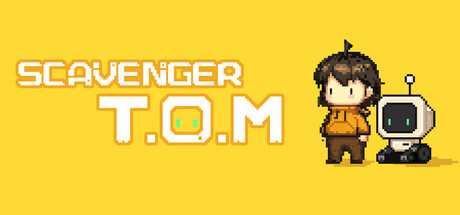
Scavenger T.O.M utilizes AI-based environment generation technology to explore and reconstruct the radiation-ravaged surface in real-time. In hazardous areas where players cannot venture directly, AI acts as T.O.M’s eyes and analytical core, dynamically processing the environment based on movement paths.
The Diffusion model-based AI system goes beyond simple image generation, creating explorable spaces at the object level and seamlessly integrating them into the game environment to enhance interactivity.
Through this technology, Scavenger T.O.M provides a unique survival environment that evolves with the player's exploration. Step into the AI-generated wasteland and craft your own survival strategy.
RaceOnLife uses AI-driven NPC systems to create more dynamic interactions inside the game world.
Some NPCs are designed to remember previous conversations, react to the player’s behavior, and respond differently depending on how the player communicates with them. These interactions may affect how NPCs guide, assist, ignore, challenge, or oppose the player during gameplay.
Our goal is to make the island feel more alive, where conversations with non-player characters are not just static dialogue lines, but part of the player’s personal journey through the story and open world.
AI features are used to support NPC behavior, dialogue variation, and player interaction systems. Core gameplay, world design, missions, vehicles, races, combat, progression, and major story content are created and directed by our development team.
For live AI interactions, we are working with safety rules and moderation limits to reduce the risk of inappropriate, harmful, or illegal generated content.
Connects to 3rd-Party Service for AI Content Generation: openai.com
Alchemy of the Earth contains limited generative AI, for things like item icons, audio, and interface backgrounds. No generative AI was used in the creation of any 3D assets, music, writing, or environment/level design.
We used generative AI for: art on the store page, and some in-game textures. Each AI-generated content was then manually adjusted by our in-house artist to ensure the presence of human input in the art and high quality of the game.