Public Steam disclosure research27,953 disclosures tracked
Where do games disclose AI use?
Search developers’ Steam disclosures, compare classified AI use across
games, and follow recorded changes.
This index adds cross-game classifications and statistics to
statements published on individual store pages.
Groups reflect automatic analysis of public disclosures; mature records are excluded. These counts do not measure AI use across all of Steam.
Missing or unclear statements cannot establish whether a game uses AI.
I use generative AI tools in the development of OXYTOPIA. All AI output is directed, reviewed, and edited by me before it ships.
What AI is used for:
Branding art — the game's logo and app/store icons were designed with the help of AI models and are rendered in-engine as original vector/code artwork.
Source code — parts of the game's code were written with AI coding assistants.
What is not AI-generated: the in-game gameplay art (tiles, characters, buildings, items, plants) and all audio are hand-made or licensed from human creators.
At runtime: OXYTOPIA generates no content with AI while you play, and no player data is ever sent to any AI service during gameplay.
This game uses generative AI for some pre-generated content. Specifically, generative AI tools were used in the creation of some in-game background/wallpaper assets and some in-game background music. All such content has been reviewed, selected, and edited by the developer before being included in the game. The game does not use live-generated AI content during gameplay.
Although AI tools were used during the making of this game for efficiency, we have put our love, care, and effort into every part of it so players can experience the game as intended.
AI was used only as a support tool where helpful, and its use was kept minimal. All creative decisions, final content, and gameplay direction were reviewed and shaped by the developer to make sure nothing takes away from the intended player experience.
Some pre-generated 3D art assets and textures were created with generative AI tools during development. These assets are reviewed, selected, adjusted, and integrated by the developer before inclusion. The game does not provide player-facing real-time generative AI features.
Some visual assets and portions of the game's development were created with the assistance of generative AI. AI was used as a creative and productivity tool during development, with all generated content reviewed, edited, and integrated by the solo developer.
Veyrasol uses generative AI tools as part of its art pipeline. Both 3D models and 2D artwork used in the game (illustrations, backgrounds, UI and unit icons), as well as store page and marketing graphics such as capsule images and banners, were created with the help of generative AI tools and then reviewed, edited and assembled by the developer. Generative AI tools were also used to help write parts of the marketing website and store page copy. The core game (engine, server logic, real-time combat, and systems) is hand-coded by the developer, and no content is generated by AI at runtime during play.
To Raise a King was made by one person working with AI collaborators. AI tools were used in the following ways during development, and every AI output shipped in the game was reviewed, curated, edited, and approved by the developer before inclusion.
Source code. Written in collaboration with Anthropic's Claude, with the developer directing architecture, reviewing every change, and testing behavior.
Character and scene illustrations. Generated locally with the FLUX.2 image model running in ComfyUI. Prompts, reference images, layered compositions, and final selections were all authored and curated by the developer.
Voice acting. Voices were produced with ElevenLabs. The developer cast each role, wrote each line, directed the delivery through iteration, and hand-picked the takes shipped in the game.
Music and sound. Music and select sound effects were produced with ElevenLabs' music generation. Tracks were selected, edited, and placed by the developer.
Writing and design. Story beats, dialogue, and system design were developed collaboratively with Claude, with the developer as the final author.
The developer confirms they hold or have licensed the rights to use these tools' outputs commercially, and has taken reasonable steps to ensure no infringing or unlawful content was produced.
We use AI-generated or AI-assisted content for some announcement and promotional materials, including announcement screenshots, trailers, GIFs, and game icons.
The final release version of the game will not use AI-generated content.
Generative AI is used only to assist with localization and translation of game-related text. No gameplay, artwork, audio, or other player-facing content is generated by AI.
Salt and Soil uses generative AI during gameplay to create some Annual Family Council narrative text and structured choice outcomes based on the current campaign state. Generated council content is constrained by the game’s historical setting, family data, localization rules, and gameplay schema, then validated before it is shown to the player.
AI is used during our early Alpha development phase to create temporary placeholder art. The intent is to replace once the core game loop as been satisfied.
A pre-rendered cinematic intro sequence was created with the assistance of AI-based video generation tools. Some visual assets were generated or refined using AI image generation.
This game uses AI-generated content, created during development and included as fixed, pre-generated assets in the shipped game (not generated live or dynamically during gameplay).
3D models: Unit, structure, and Titan models are generated using Meshy, an AI text/image-to-3D generation tool.
Music: The game's background soundtrack (16 tracks) is generated using Suno, an AI music generation tool.
Some of the images in the game were generated using AI during the prototype stage. Such assets may be present in the game up until the release of the demo (inclusive). During the development process, we gradually get rid of generated assets and replace them with hand-made ones. By the time of the official release, all generated content will be removed. This is a normal process for developing an indie game.
This game includes live-generated AI features that run locally on the player's computer and do not rely on external AI services.
The game uses AI to:
- interpret the player's spoken voice commands in real time to support gameplay interactions;
- generate voice audio for in-game pilot communications in real time.
The AI systems are used exclusively for these gameplay functions. They do not generate user-visible images, text, or other open-ended content.
The game is designed so that AI-generated output is limited to its intended gameplay purpose and cannot be used to create illegal, infringing, or otherwise prohibited content.
We use AI to translate the store steam page to different languages. This will be changed on release and we will hire professional translators for this purpose.
AI tools were used in a limited capacity during the development of the game, primarily to assist with certain programming tasks and the creation of temporary assets.
No AI-generated content is created in real time while playing the game.
We used generative AI mainly for generating code. It has also been used for writing flavour text, many interface descriptions and some lines for an AI character. Finally it has also been used for proofreading.
Deeprise is a solo-developed indie game. Generative AI was used as a tool in the creation of this game, specifically for:
- Concept art and illustrations (character portraits, enemy designs, environment backgrounds, building art, item icons, and research card art), generated with AI image tools and curated, edited, and integrated by the developer.
- Sound effects and voicelines, generated with AI audio tools using developer-written scripts and prompts.
- Capsule art and store page imagery, created by compositing AI-generated assets with developer-designed layouts.
All game design, systems, code, writing, lore, and creative direction are the developer's own work. AI was used to bring this solo project to a visual and audio polish that would otherwise be out of reach for a single developer, and every AI-generated asset was reviewed, selected, and integrated by hand.
Cellula was developed with the assistance of generative AI tools. The developer used AI to help write C++ code, generate 3D organelle models from text descriptions, and create UI button artwork. No AI-generated content appears in the final game without human modification, curation, and integration.
This project is itself a demonstration of how AI can democratize game development — allowing a single developer with domain expertise but limited programming experience to build something that previously required a full studio.
All game design, biological accuracy, educational content, and creative direction were provided by a human physician and educator.
Artificial Intelligence was used to help in the development of game code only. No art, sound, or other visual assets use or employed AI and were done by a real artist on the team.
Generative AI tools were used only to assist in the creation of certain store page and marketing images. No AI-generated content is created during gameplay, and the game does not use live AI systems or connect to external AI services while running.
The game's narration engine is a deterministic template system with zero runtime AI. The template/fragment library it draws from was hand-crafted in English, and then mass-localized during development using a large language model and then human-curated. No AI image generation was used: all art, icons, and store assets are procedurally rasterized from hand-authored primitive op-lists. The game contains no live/runtime AI generation.
Godwright ships some generative-AI content, all pre-rendered (baked into the build, never live-generated):
Localization: the non-English UI text (Simplified Chinese, Spanish, Portuguese-BR, Russian, German, French, Japanese, Korean, Turkish, Indonesian) was machine-translated.
AI was used to create background images in the novel, as well as objects in the levels, but the levels are drawn to the final stage manually by an artist.
This project uses a mix of human-made and AI-assisted content. The majority of visual assets are human-made. Some 3D character models, item models, and textures were generated with the help of AI tools. All animation, audio, music, sound design, and writing are entirely human-made.
Irondrive's game design, code and writing are human-made. Some art and audio assets were created with the help of AI tools and then edited and integrated by hand.
Generative AI tools were used to assist with development, including code support, store text drafting, and some visual/marketing assets. Final content was reviewed and edited by the developer.
AI tools were used to assist in the creation of temporary promotional artwork and concept visuals for the Steam store page. Gameplay systems, implementation, balancing, and final game integration are developed manually.
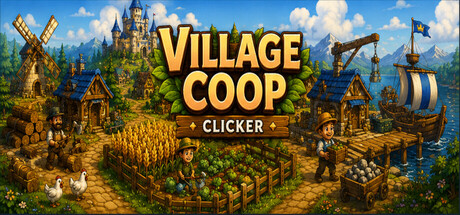
Village Coop Clicker is a small hobby project created with extensive use of AI-assisted tools for programming, artwork, audio, localization, and store assets.
The game design, balancing, progression systems, and overall creative direction were created and curated manually by the developer.
Some visual assets and promotional materials for this game were created or assisted using generative AI tools. All content was reviewed, edited, and integrated by the developer.