Public Steam disclosure research27,951 disclosures tracked
Where do games disclose AI use?
Search developers’ Steam disclosures, compare classified AI use across
games, and follow recorded changes.
This index adds cross-game classifications and statistics to
statements published on individual store pages.
Groups reflect automatic analysis of public disclosures; mature records are excluded. These counts do not measure AI use across all of Steam.
Missing or unclear statements cannot establish whether a game uses AI.
Generative AI (OpenAI ChatGPT) was used to create the title/boot key art and the 20 achievement badge icons. The game's code — which procedurally generates the city, UI and synthesized music — was written with AI coding assistance (Anthropic Claude).
This game uses AI-generated images for some of its 2D artwork, character
scenes, and store page visuals. All AI-generated content is reviewed, edited,
and curated by our team to fit the game's historical setting. The game's
design, writing, story, and code are created by human developers.
Some visual assets and parts of the development workflow for Forest of Numbers were created with the assistance of generative artificial intelligence tools. All content was curated, reviewed, and refined by the developer before being included in the final game.
Chessferatu Graphics were generated using AI tools. Codex was used in the process of creating and refining code and in the porting of the code to different systems (Mobile to PC).
trailer is generated with ai
some objects is generated with ai
character rendering generated by ai
cutscene generated by ai
voice and music generated by ai
This game utilizes generative AI technology during development. The game's program code, art assets (including characters, scenes, and props), as well as music/sound effects, were generated with the assistance of AI. Game design, project management, gameplay conception, overall development, testing, and debugging were all performed by a human developer. All AI-generated content has been manually curated, modified, and integrated to align with the game's cultural theme and quality standards.
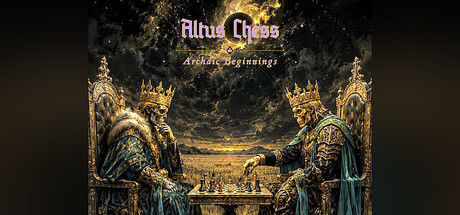
All visual artwork in Altus Chess: Archaic Beginnings — piece designs, board and background art, and promotional/store imagery — was created using generative AI image tools, directed by the developer through human-written prompts based on the game's own pieces and concepts, then reviewed and edited by hand. No content is generated live during gameplay. The game's opponent is a proprietary, hand-built algorithmic chess engine, not generative AI.
The game includes generative AI in the form of relatively structured conversation (voice and/or text to prompt) in context with the setting and era of the documented sites (caravanserai) you will visit.
Some visual assets used for the Steam store page and marketing materials, including logos, promotional artwork, capsule images, and library assets, were created or assisted using generative AI tools and then reviewed, edited, and finalized by the developer.
No AI-generated content is created during gameplay. AI-generated content is limited to pre-generated promotional and store page materials and does not affect gameplay, game mechanics, or player-generated content.
Some visual assets (such as store page graphics, backgrounds, and UI elements) and the localization/translation of the game's user interface were created with the assistance of generative AI tools. All core gameplay mechanics and code are strictly human-made, and no live AI content generation occurs during gameplay
Some visual assets used for HackMeNow’s Steam store page, community assets, and marketing materials were created with the assistance of generative AI tools and then reviewed/selected by the developer.
The game itself does not use live generative AI during gameplay. No AI system generates player-facing text, images, audio, code, missions, or other dynamic content while the game is being played.
Elftia is an AI agent platform. Through an included service, it connects to leading third-party AI models - large language models and image, video, music and speech generators - to power its agents. Elftia does not bundle, train or fine-tune any model of its own; all content is generated in real time by those models in response to the user's input. New users receive free starter credits, and additional usage can be purchased through Steam. Conversations and generated content are saved to the user's local library on their device.
1) Bundled sample project. All of the Quillhollow-specific data in the optional, read-only "A Christmas Carol" sample project was AI-generated to demonstrate how the app organizes a manuscript: the character, location, plot-thread, theme, and world-building cards and their descriptions, along with tags, links, beats, pins, and scene statuses. The sample's prose is the public-domain text of Charles Dickens' A Christmas Carol (from Standard Ebooks, released under CC0) and is not AI-generated.
2) Store page and marketing text. Some of the written copy on the store page and in our marketing materials was drafted with AI assistance and then reviewed and edited by a human before publication.
Some of the English text content and translations in this game were created with the help of generative AI tools. All text has been reviewed and edited by our development team to ensure accuracy and educational quality.
Generative AI was used to create initial game art concepts and certain marketing materials. Final in-game assets were reviewed and modified by the development team.
Authorisation Engine uses generative AI tools during development to assist with selected pre-generated assets and production materials, including some store artwork and audio/localization workflow support. All such content is reviewed and curated before inclusion. The game does not live-generate gameplay content with AI at runtime.
Pixel Q is a local AI assistant that utilizes large language models (LLMs) for real-time conversational AI. All AI models run locally on the user's device. Safety guardrails are enforced through restrictive prompt engineering, output filtering, and the inherent safety features of the underlying open-source models. The AI is designed to refuse requests for illegal, harmful, hateful, or sexually explicit content. No user data is sent to external servers.
New Science uses generative AI as a core part of its discovery system. When a player attempts a combination, an AI model may be used to determine whether the two selected objects can logically produce a new result. Generative AI is also used to create an illustration for newly discovered objects. Known discoveries are stored and reused, so the same established combination does not need to be generated again for every player. This system allows New Science to support open-ended experimentation beyond a small, completely predefined recipe list. Players may therefore encounter newly generated combinations and images that have not previously been seen by the development team.
Foundation Typer uses generative AI-assisted artwork, voice, and cinematic media elements for certain visual and promotional content, including portions of trailers, character presentation, and store assets. All gameplay systems, lesson structure, progression design, typing mechanics, interface functionality, and core training content were created and assembled as part of the game's original development.
Generative AI tools were used only for a very small portion of the store's promotional assets and concept designs to assist the workflow. The vast majority of the game, including its core mechanics, code, and structural design, has been developed traditionally by our team. All AI-assisted elements have been heavily edited, verified for copyright compliance, and do not contain any illegal material.
The life events for every historical figure highlighted in the game were generated by giving AI access to their Wikipedia profiles and asking it to summarize the text content. The art and the code are entirely human.
Knave Craps uses generative AI for some pre-rendered content. Specifically:
- Visual art: Theme artwork used in the game's user interface and the Steam store hero/capsule images were created with the assistance of AI image-generation tools. All generated images were curated, edited, and integrated into the game by the developer.
- Voiceovers: "Hot shooter" announcement audio (played during bonus side bets such as the Fire Bet) was created with an AI text-to-speech voice model. Scripts were written by the developer.
The game does not use any live-generated AI content. All gameplay logic, dice rolls, payouts, and bet resolution are deterministic and authored.