Public Steam disclosure research27,951 disclosures tracked
Where do games disclose AI use?
Search developers’ Steam disclosures, compare classified AI use across
games, and follow recorded changes.
This index adds cross-game classifications and statistics to
statements published on individual store pages.
Groups reflect automatic analysis of public disclosures; mature records are excluded. These counts do not measure AI use across all of Steam.
Missing or unclear statements cannot establish whether a game uses AI.
This game does not include AI "art". Anything with an artistic quality, rather than an attempt to emulate a realistic texture, was created by a human.
Photorealistic AI-generated images were sampled to create some of the game's textures, and often heavily edited since raw output is unsuitable.
3D models, sounds, and music in this game were created by a human with zero AI assistance.
This game was developed with the extensive use of generative AI 'Gemini' for many processes, including coding and image generation. While AI helped improve development efficiency, all final adjustments and quality control were done manually to ensure a polished experience for players.
Some in-game assets are developed with the help of generative AI tools. All AI-assisted outputs are reviewed and edited before use. No AI-generated content is created live at runtime.
A very small portion of the visual artwork and environmental paintings in Phobophobia 1.0 – The Experiment were assisted by generative AI during development, used only sparingly for artistic refinement.
The game itself including all gameplay, story, and core content is 100 percent created by human developers, with no AI generated content used in game or produced live.
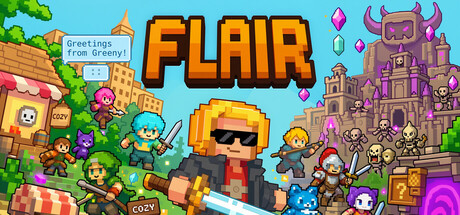
FLAIR uses generative AI to bring your ideas to life. Players can describe characters, items, buildings, or world elements, and the game will generate them directly in-game. Your creativity shapes the world.
Our game uses generative AI during the development phase to create pre-rendered content including maps (using a Large Language Model) and code generation (using Claude AI). This content is finalized before release and included in the game and its marketing assets. We ensure all AI-generated content complies with copyright laws and Steam’s guidelines, and does not contain any infringing or inappropriate material.
The game does not use AI to generate any content or code live during gameplay. All AI-generated elements are pre-rendered before release. We comply with Steam’s standards distinguishing pre-rendered and live-generated AI content.
I’m a solo developer, and I use generative AI as a creative tool to help bring the game to life, from text, images, or music to bits of code.
Every piece of AI-generated content is carefully reviewed, edited, and refined by me to fit the game’s vision. This helps me create more content, add variety, and make a better, more immersive experience for players.
<3
This game contains pre-created images that were generated using generative AI.
The AI content is used only as static graphics within the game and in marketing materials.
No AI generation takes place during the runtime of the game.
We are using an AI-generated capsule image for our market research and testing phase. Once we wrap up these tests, we will create and share the final hand-painted capsule art.
Some background music tracks were generated with the assistance of generative AI during development.
All AI-generated music has been manually reviewed, edited, and verified by the developer to ensure it does not infringe on any copyrights or intellectual property.
The application itself does not include any generative AI functionality.
Some sound effects were generated using ElevenLabs AI tools during development. No AI is used during gameplay.
I definitely would replace them with custom sound design in future updates if my finances allow it.
In the game, AI tools were used to assist in completing the code and drawing work, and most of the content generated by AI was manually reworked in the later stage.
We utilized AI technology in areas such as UI design and story text. However, we also performed secondary manual processing on these elements; we did not directly use AI-generated assets and text.
Furthermore, apart from the aforementioned content, all other parts of the game were created manually and did not use AI.
Some images and icons in the game were generated with AI and post-processed manually.
In-game music and voice-overs are AI generated.
More details on my use of AI in my devlog: https://lemuria.org/devlogs/ta-07/
In the game, AI technology was used to assist in generating the majority of the art and audio assets, specifically the UI, character illustrations, background illustrations, and background music. To achieve the desired visual effect, I will manually make secondary modifications to the generated assets after they are produced.
I am fully aware that AI-generated work cannot compare to the creations of outstanding artists and musicians, and I completely understand any attitude you may hold toward AI. If you are still willing to give this game a try, I would like to explain:
I apologize that, as an independent developer, from a financial standpoint, it has become difficult for me to afford a large amount of art and music content. However, this does not mean I will treat this work lightly. I have already conducted multiple rounds of optimization and replacement for the game's art and music, and this work will continue. I will bring my sincerity and dedication, within the limits of my ability, to gradually pursue results that are more satisfying to everyone.
AI-Generated Content Disclosure
I am a solo developer with no programming background. Before using AI, I spent three months following YouTube tutorials, deleted everything and restarted three times, and typed every line of code myself until the foundation of this game clicked.
From there, I used AI — primarily Claude — as a teacher and debugging partner across 7,000+ conversations over 16 months to learn GDScript and build every system in the game. The first line in my prompts is always "Stop being a yes sayer and always be brutal and honest."
Here is exactly what AI was and wasn't used for:
Code: I spent my first three months writing every line of code by hand. As the project grew, AI became a development partner — drafting code from my descriptions, which I then reviewed, debugged, and integrated. AI taught me programming concepts and helped me solve problems. Every design decision and system architecture is mine.
Art: AI-generated with extensive human direction and manual editing. Some pieces required 15 pages of descriptions. I often assemble final art from multiple elements — finding references, combining parts, and making hands-on edits until it matches my vision.
Animation: The first 14 enemies and 2 bosses were animated by me personally in DragonBones. For newer content, I'm exploring AI-generated animations and working to make them feel personal and consistent with the game's style — you can see examples with the later bosses. Some of these I'm still not satisfied with and will redo, which is just part of the process.
Music: I produced 350+ tracks using AI music tools and curated the best for the game. All creative direction — mood, style, placement — is mine.
Writing: All card text, lore, descriptions, and UI text are written by me. AI occasionally helps with polish.
Game Design: Every mechanic, card interaction, and balance decision comes from a lifetime of gaming — hundreds of board games, decades of Magic: The Gathering, a career at Blizzard Entertainment, and more consoles than most people can count. AI does not design games. That part is entirely human.
EDIT1: I felt the need to mention that I got diagnosed with ADHD last year, at the age of 47. The reason I could never learn coding in a traditional way is my attention span. If I am not interested it is super hard, and if I am interested it is super awesome. I get excited when I can talk and describe how I want my game to feel and function. The AI converts that to code, and together we've created a way for me to follow my dream and make a game that I want to play. I have thought to myself many times during development that I wish I knew how to make this myself, and I wish I was able to just learn and do things like most people. But here we are.
"EDIT2: I updated the Code section to be more precise. I only wrote code entirely by hand for the first three months. After that, AI and I worked together — I designed and described what I needed in detail, AI drafted it, and I reviewed, debugged, and integrated everything."